Review · MEXICO CITY
Walking Tour – Impressive murals in Historical Center of Mexico City
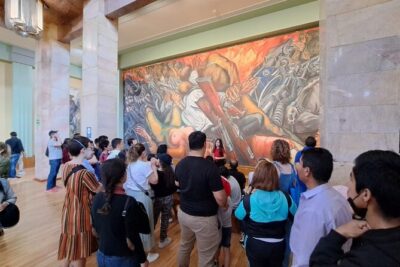
Mexico City’s great murals are not background decoration. They are huge arguments about conquest, workers, religion, revolution, and national identity. This walking tour brings you close to that story, from Diego Rivera’s first mural at San Ildefonso to the grand works inside Bellas Artes. Balaam and Miguel are especially strong guides, explaining symbols and politics in clear English.
I like the way the tour connects paintings to the streets, churches, squares, and buildings around the Historic Center. I also like the flexible pace: guides have helped with bathroom stops, street food, and even an e-bike taxi when the walking became too much. The main caution is practical: expect nearly three hours on your feet, and check the day carefully because the Education Ministry is closed on Tuesdays.
Key points before you book
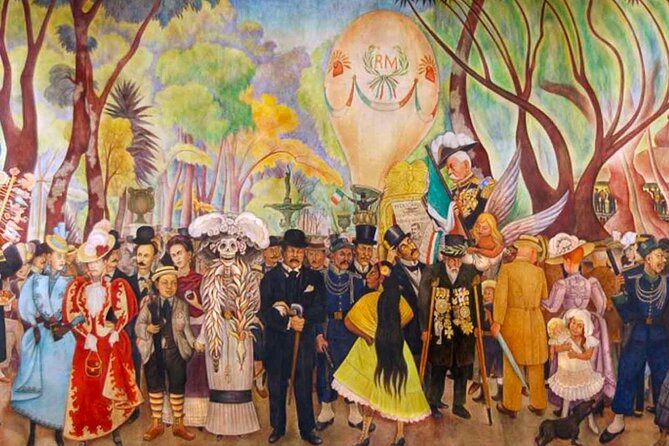
- See Rivera’s first mural: La Creación fills the amphitheater at the former College of San Ildefonso, where Rivera first met a young Frida Kahlo.
- Walk through 3,000 square meters of murals: The Education Ministry’s Fiestas and Trabajo courtyards contain works by Rivera, Jean Charlot, Amado de la Cueva, and Roberto Montenegro.
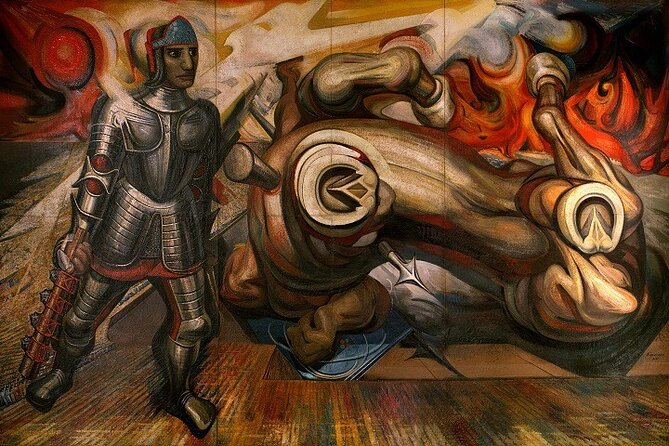
- Expect history, not just art: The guides explain Aztec stories, Spanish conquest, the Mexican Revolution, labor, religion, and political ideology.
- Finish at Bellas Artes: Mexico’s grand cultural palace holds murals by several major Mexican artists, though admission there is not clearly covered in the same way as the other stops.
- Plan for a long walk: The tour covers several Historic Center sites and usually lasts close to three hours.
- Tuesday needs special care: The Education Ministry closes that day, so the route changes to other mural sites, including the Diego Rivera Mural Museum.
Why Mexico City’s murals need a guide
You can certainly walk into a museum and admire the colors on your own. The challenge is knowing what you are looking at. Mexican muralism is full of figures, symbols, political references, indigenous stories, and historical moments that are easy to miss from a few feet away.
This tour helps turn a wall into a readable story. A guide may point out how Rivera used workers, peasants, soldiers, religious figures, and political leaders to make an argument about Mexican society. You also get the setting around the art: old school courtyards, government offices, public squares, and a palace built for national culture.
The strongest guiding comes from people such as Balaam and Miguel. Balaam is particularly good at explaining the political and social pressures behind muralism from the 1920s through the 1960s. Miguel brings an art historian’s interest, but also adds comments about architecture, archaeological remains, churches, and street food along the route.
That makes the experience useful even if you are not an art specialist. You do not need to arrive knowing Rivera from Orozco. You only need enough curiosity to look closely and ask questions.
More Mural Tours in Mexico
- CDMX: Xochimilco, Coyoacan, Frida Kahlo Museum & Murals Tour
★ 4.4 · 3,025 reviews - Cancun Street Food Tour with Food Stalls, Local Market and Murals
★ 5.0 · 723 reviews - Mexico City; ART NACO : Murals & Street Art Bike Tour
★ 5.0 · 284 reviews
San Ildefonso and Rivera’s first mural
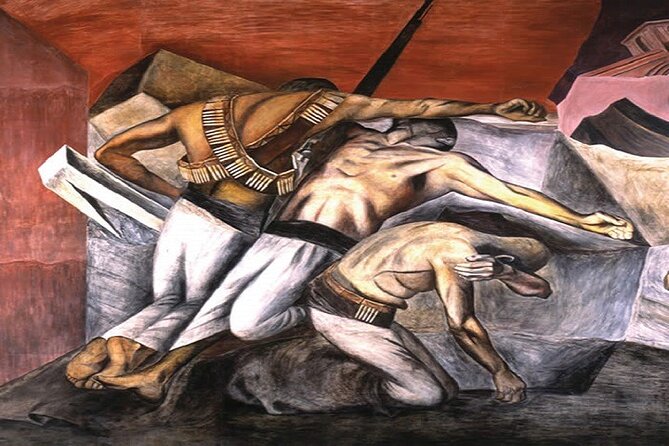
The tour begins at the former College of San Ildefonso, at Justo Sierra 16. The old National Preparatory School is closely tied to the birth of Mexican muralism, and the building itself gives the opening stop a sense of place that a stand-alone gallery cannot match.
The key work here is La Creación, Diego Rivera’s first mural. It decorates the amphitheater, so you see it in an architectural setting rather than as a framed object. The location also carries a personal connection: Rivera met a teenage Frida Kahlo here for the first time.
You get about 30 minutes at this stop, with admission included. That is enough time for a focused explanation and a close look, though serious art lovers may wish for longer. The guide’s interpretation matters here because the mural’s religious and symbolic elements can feel dense at first glance.
I would pay attention to how the tour begins with Rivera before moving into the larger public program of Mexican muralism. It gives you a useful starting point: one artist, one building, and one early work before the route expands into government-sponsored art and national culture.
The Education Ministry’s courtyard murals
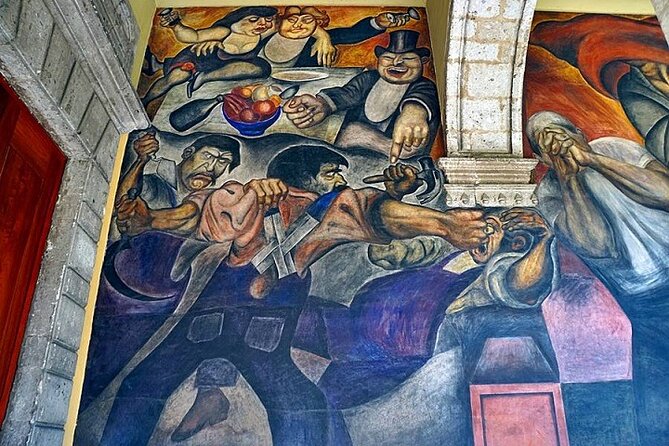
The Ministry of Public Education is the artistic heart of the route when it is open. Its Fiestas and Trabajo courtyards contain more than 3,000 square meters of murals, so this is not a quick look at one famous wall. You walk through a large body of work by Rivera and other important artists, including Jean Charlot, Amado de la Cueva, and Roberto Montenegro.
The courtyard setting changes how you experience the paintings. Instead of moving from gallery room to gallery room, you encounter murals as part of a working public building. The art surrounds you as you move through the space, and the sheer quantity helps explain why Mexican muralism was meant for ordinary people, not just museum visitors.
A 40-minute visit gives the guide time to select important details instead of rushing past every panel. You may also see two rooms devoted to muralism, a multisensory hall with art and historical material, a library, a children’s reading room, an FCE bookstore, and a café.
The building is closed on Tuesdays. This is the most important scheduling issue on the tour. The experience still goes ahead with substitute mural sites, including the Diego Rivera Mural Museum and other works in the Historic Center, but the route is different. If the Education Ministry is your main reason for booking, choose another day.
There is also a useful lesson here about flexibility. The route has been adjusted when an unexpected protest closed the building, and the guide waited and returned when it reopened. That kind of patience can matter in central Mexico City, where public events and access conditions can change.
Bellas Artes and the grand finale
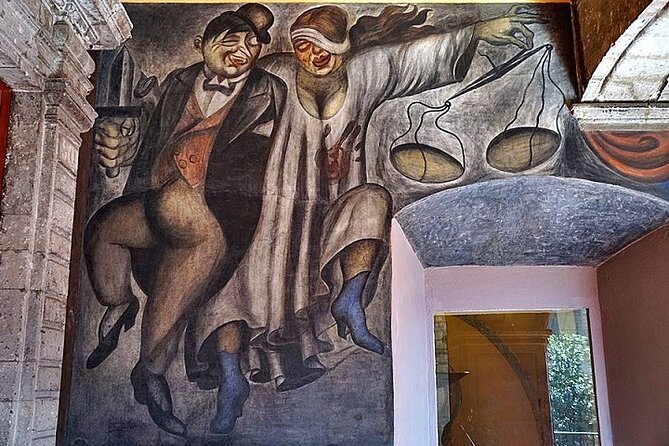
The final scheduled stop is the Palacio de Bellas Artes on Juarez Avenue. Its white exterior and domed profile make it one of the most recognizable buildings in the Historic Center, but the murals inside are the real reason to visit.
The palace opened in 1934, and several Mexican muralists received commissions for its walls shortly before the inauguration. The building now hosts exhibitions, dance, theater, and other cultural events. Its museum, opened at the same time, was the first museum in Mexico.
The tour gives you about 40 minutes here. That is enough to focus on the mural collection and understand how the works fit into the building’s national role. Guides often connect Rivera and Orozco to the political climate that shaped their work, and you may also encounter murals by David Alfaro Siqueiros and other major figures, depending on the route and current access.
One famous point covered on the route is Rivera’s mural connected with Rockefeller Center, now seen at Bellas Artes. The building’s art rewards a guide who can explain not only what appears in the scene, but why the image caused controversy and how it relates to Rivera’s political views.
Be aware of the admission wording. The experience includes museum entrance tickets in its general inclusions, but the Bellas Artes stop is also marked as admission not included. I would confirm the exact ticket arrangement at booking so you know if an extra entrance fee is required.
More Mural Tours in Mexico City
- Muralist Art Semi Private Walking Tour in Mexico City Downtown
★ 5.0 · 188 reviews - Mexico City: Art Naco, murals & street art bike tour
★ 4.7 · 166 reviews - Xochimilco floating gardens, Coyoacan and UNAM murals
★ 4.0 · 53 reviews - Mexico City: Diego Rivera’s Murals Guided Walking Tour
★ 5.0 · 49 reviews
What the walking route feels like
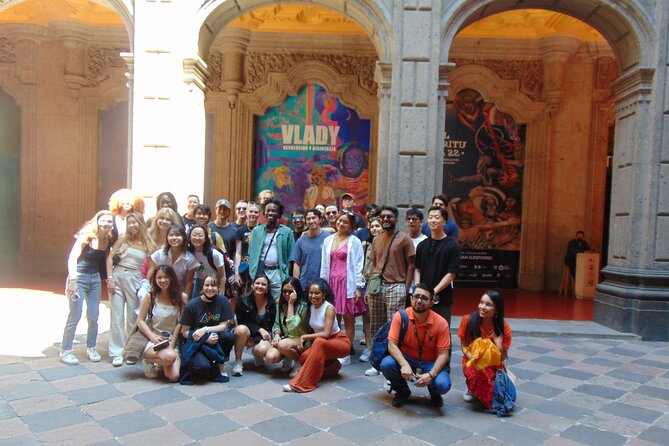
This is a city walk with museum visits, not a seated lecture. You move between buildings in the Historic Center and spend much of the time standing while looking up at walls. Comfortable shoes are essential, and the pace may feel ambitious if you walk slowly or have limited stamina.
The stated duration is one to three hours, but the detailed visits add up to about 110 minutes before transfers and explanations. In practice, many tours run close to three hours. A particularly engaged guide may take longer when questions are flowing, which is good for depth but less convenient if you have a tight afternoon plan.
Group size can reach 25 people. That is manageable in the larger courtyards, but a dozen people can already feel crowded when the guide is explaining a small detail or trying to position everyone in front of a mural. Smaller departures are more personal, and solo bookings have sometimes resulted in a one-to-one experience.
The route ends at Bellas Artes rather than returning to San Ildefonso. That makes it useful as a way to cross the Historic Center and continue your day near Alameda Park and Juarez Avenue. Transportation between sites is not included, though the route is primarily on foot.
The history behind the images
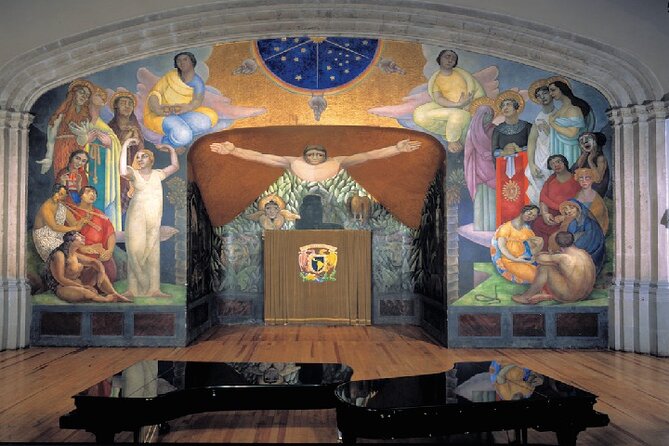
The tour’s real value is the connection between art and Mexican history. The murals grew out of a period when Mexico was rebuilding its public identity after revolution. Government buildings became places where artists could show scenes of work, indigenous culture, education, conflict, and social change to a broad audience.
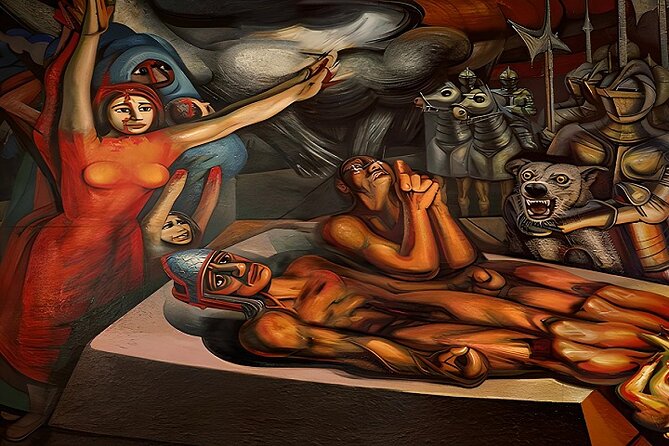
That background helps you read Rivera’s choices. His figures are rarely random decoration. A worker, a peasant, a conquistador, a priest, or an indigenous symbol may carry a political point. The guides also explain Aztec origin stories and religious imagery, which can clarify references that otherwise seem mysterious.
You will hear about the conquest, the Revolution, labor movements, and the political arguments of artists such as Rivera, Orozco, and Siqueiros. The emphasis is often strongest on Rivera, so anyone expecting equal time for every muralist should set expectations accordingly.
The discussion can be political. That is not a flaw, since politics is central to the movement, but it may feel like an art history and Mexican history class combined. I find that useful because the paintings lose much of their meaning when treated as simple colorful scenes.
Guide quality and language
The guides are the tour’s biggest strength. Balaam is repeatedly praised for his passion, careful explanations, and ability to connect symbols with indigenous culture and political history. Miguel is also a strong choice, especially if you enjoy a guide who adds architecture, local customs, and broader city context to the art.
Both guides have been described as warm, flexible, and willing to answer questions. Balaam has adjusted breaks, helped with a street food stop, and changed the transport plan when one person found the walking route too demanding. Miguel has tailored the discussion to a group’s interests and made the history easy to follow.
English is offered, but accents and fast explanations can occasionally make a complicated point harder to catch. If you do not understand something, ask the guide to repeat it. The subject is too important to let one missed sentence pass.
The maximum group size is 25, so do not assume a private tour. If you want the most personal experience, a small departure is preferable. Still, the guides appear comfortable handling both larger groups and one-to-one visits.
Is $51 a fair price?
At $51 per person, this is not the cheapest way to see a few murals. The value depends on how much interpretation you want. If you only want to photograph famous works, you can visit some sites independently for less, assuming you manage admissions and opening days yourself.
The price makes more sense if you want the murals explained in context. You are paying for a guide who can identify the important panels, connect them to Mexican politics and culture, and help you navigate several Historic Center buildings in a short visit. Museum tickets are included in the stated package, though Bellas Artes admission should be confirmed.
Group discounts may reduce the cost for larger parties. The tour is also offered in morning and afternoon time slots, which helps you fit it around other plans. Free cancellation is available until 24 hours before the start time. After that, the payment is not refunded, and changes are not accepted.
Who should book this mural walk?
I would choose this tour if you have a strong interest in Diego Rivera or want a clear introduction to Mexican muralism. It is also a smart first activity in Mexico City because the guide supplies historical background that can help you understand other museums and landmarks later.
It suits couples, families with older children, solo visitors, and small business groups. The art is serious, but the route includes everyday city details and room for questions. It is especially useful if you have only a day or two in the capital and want several major mural sites in one organized outing.
I would think twice if you dislike walking, standing, political discussion, or group pacing. The route may be tiring, and Tuesday visitors will not see the Education Ministry itself. If that building is your priority, book Wednesday through Monday and allow close to three hours.
Should you book it?
Book it if you want the murals to make sense rather than simply look impressive. The best guides, especially Balaam and Miguel, explain the people, symbols, and political conflicts behind the paint, while the route places the art inside Mexico City’s living Historic Center.
Choose a non-Tuesday date, wear comfortable shoes, and confirm the Bellas Artes admission details. With those points handled, this is a strong value for art lovers and a particularly good way to begin learning how Mexico tells its own story through public art.
FAQ
How long does the mural walking tour last?
The stated duration is approximately one to three hours. The three main visits total about 110 minutes, and many departures run close to three hours once walking and explanations are included.
Where does the tour begin?
It begins at the Former College of San Ildefonso, at Justo Sierra 16 in Mexico City’s Historic Center.
Where does the tour end?
The scheduled end point is the Palacio de Bellas Artes on Juarez Avenue in the Historic Center.
Which museums and buildings are visited?
The route includes the Former College of San Ildefonso, the Ministry of Public Education, and the Palacio de Bellas Artes. On Tuesdays, the Education Ministry is replaced by other mural sites because it is closed.
Is the Ministry of Public Education open every day?
No. It is closed on Tuesdays, so the tour uses an alternate route that day, including the Diego Rivera Mural Museum.
Are admission tickets included?
Museum entrance tickets are included in the stated inclusions. However, the Bellas Artes stop is also marked as admission not included, so confirm the exact ticket arrangement before booking.
Is transportation included?
No. Transportation is not included. The experience is primarily a walking tour between sites.
How large can the group be?
The tour can have a maximum of 25 participants.
Is the tour offered in English?
Yes. The experience is offered in English.
Can I cancel for a full refund?
Yes, if you cancel at least 24 hours before the experience start time. Cancellations within 24 hours are not refunded, and changes during that period are not accepted.
More Street Art Walking Tours in Mexico City
- Mexico City: Historic Center Walking Tour with Murals
★ 5.0 · 6 reviews - Mexico City: The Murals of Mexico Semiprivate Walking Tour
★ 5.0 · 2 reviews - Mexico City: History on Walls. Mexican Murals Walking Tour
★ 5.0 · 2 reviews
More Street Art Walking Tours in Mexico
- History and Murals: Walking Tour Guadalajara
★ 5.0 · 237 reviews - Guided Walking Tour Describing UNAM Murals and Revolution
★ 5.0 · 8 reviews - Street Art Walk
★ 4.5 · 7 reviews - Private Walking Tour Guadalajara History and Murals with Guide
★ 5.0 · 6 reviews
Freshly painted around Mexico
- Xochimilco floating gardens, Coyoacan and UNAM murals★ 4.0 · 6 reviews
- UNAM: Murals & Revolution★ 4.9 · 8 reviews
- Street Art & Cemetery Cultural Tour – half day★ 5.0 · 3 reviews
- Graffitis & Munchies biketour Playa del Carmen★ 4.5 · 18 reviews
- Street Art Walk★ 4.5 · 7 reviews
- Tour Women Muralists : Strokes that resist Mexico City★ 5.0 · 7 reviews
- Diego Rivera’s murals, hidden treasures★ 5.0 · 21 reviews
- Private Street Art Tour in Rome★ 4.0 · 4 reviews
Mexico City Street Art Tours, compared.

Xochimilco, Coyoacan and Frida Kahlo with Optional Lunch
Read our review →
CDMX: Xochimilco, Coyoacan, Frida Kahlo Museum & Murals Tour
Read our review →
Mexico City; ART NACO : Murals & Street Art Bike Tour
Read our review →
La Catrina & Muralism: Diego Rivera’s Legacy & Frida Kahlo
Read our review →
Muralist Art Semi Private Walking Tour in Mexico City Downtown
Read our review →
Xochimilco floating gardens, Coyoacan and UNAM murals
Read our review →
Mexico City: Diego Rivera’s Murals Guided Walking Tour
Read our review →