

Review · MEXICO CITY
Tour Evolution of Muralism paints your Grafiti
Mexico City’s mural story comes alive on this small-group walking and transit tour, ending with a chance to spray your own graffiti inside a converted flour factory. You move from colonial walls and revolutionary politics to contemporary street art, so the experience feels like a clear visual timeline rather than a quick gallery visit.
I like the strong art interpretation, especially the way guide Jorge explains symbols, politics, and the messages behind individual figures. I also like the public transportation ride, which gives you a more local view of Mexico City than staying inside a tour van. The main drawback is the pace: you cover a lot of ground, and the metro, bus, and walking may be tiring if you want a slow museum morning.
Key points to know before booking
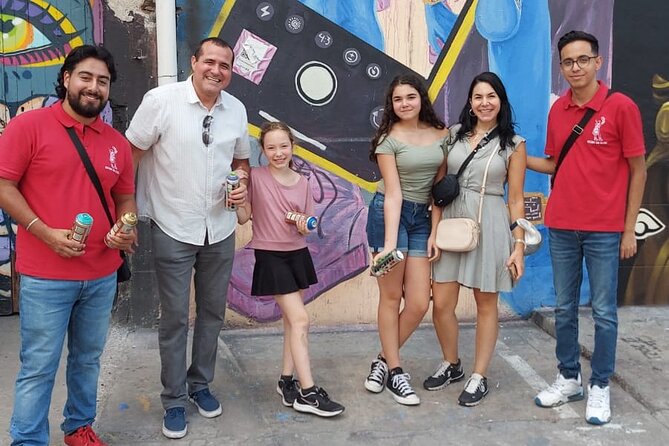
- San Ildefonso gives the tour its historical base: See murals by Diego Rivera, José Clemente Orozco, David Alfaro Siqueiros, and other major Mexican artists.
- Abelardo L. Rodríguez Market is an unusual art stop: About 1,450 square meters of walls and ceilings carry murals linked to Rivera’s students.
- The route uses public transportation: Expect the Mexico City metro and bus, with walking between stops.
- Ex Fábrica MX adds hands-on fun: The former flour factory is now an art district filled with graffiti, bars, and shops.
- The guide matters here: Jorge has been praised for explaining symbolism in plain language, while Jaime is also associated with highly rated tours from this provider.
- The group is limited to 12 people: That is useful when looking closely at murals or asking questions.
A four-hour route through Mexico City’s changing art
This experience lasts about three and a half to four hours and begins at Mexico City’s Metropolitan Cathedral in the Centro Histórico. It ends at Ex Fábrica MX in Tacuba, Miguel Hidalgo, so you should not expect to finish near the cathedral.
That point matters when planning the rest of your day. The route is not a loop, and the final stop is designed as a place to linger, eat, shop, or relax. The tour includes public transportation, but lunch, drinks, and tips are not included.
The group size is capped at 12 people. That is a good fit for an art tour because you can usually hear the guide and ask about details without competing with a large crowd. You will still be moving through active city spaces, so this is not a quiet private museum visit.
More Muralism Tours around Mexico:
- Xochimilco, Coyoacan and Frida Kahlo with Optional Lunch
★ 4.5 · 7,320 reviews - CDMX: Xochimilco, Coyoacan, Frida Kahlo Museum & Murals Tour
★ 4.4 · 3,025 reviews - La Catrina & Muralism: Diego Rivera’s Legacy & Frida Kahlo
★ 4.5 · 197 reviews
San Ildefonso: where muralism begins
The first stop is the Antiguo Colegio de San Ildefonso, about an hour and a half from the tour. The building itself is one of the major colonial structures in Mexico City’s historic center, but the murals are the reason it belongs on this route.
San Ildefonso is closely tied to the beginning of the Mexican muralism movement. Its walls carry work by Diego Rivera, David Alfaro Siqueiros, José Clemente Orozco, and other artists who helped turn public buildings into places for civic education.
This is where a good guide can make a real difference. Instead of treating the murals as large decorative paintings, you learn to look for the people, gestures, social classes, and symbols within them. Jorge has been particularly praised for breaking scenes into parts and explaining how the artists communicated political ideas.
That approach helps if you do not already know Mexican art. You do not need to arrive with a list of painters memorized. The guide connects the figures and themes to the period’s larger debates, including the effect of the Mexican Revolution and the government’s use of public art.
The visit also gives you a useful way to compare artists. Rivera, Orozco, and Siqueiros are often grouped together, but their work does not communicate in exactly the same way. Looking at their murals in one building can help you notice differences in mood, composition, and political force.
Plan to pay attention rather than simply take photographs. If Spanish names are hard to remember, one practical trick is to photograph the artist signatures or the full mural, then use those images as a reference later. The route includes many names, and they can blur together by the end of the morning.
Abelardo L. Rodríguez Market and its working-class message
The second stop shifts the setting from a former school to the Abelardo L. Rodríguez Market. The market was built in the early decades of the 20th century as a model for a modern public market, following the earlier Dos de Abril market.
Its unusual feature is the artwork covering roughly 1,450 square meters of walls and ceilings. The murals were painted by students of Diego Rivera, and the setting gives you a different experience from viewing art in a formal museum.
The paintings reflect socialist ideas promoted by the Mexican government after the 1910 Revolution. They also show the artists’ concerns about exploitation among workers, peasants, and miners. The market was a place for everyday commerce, so the art was placed where ordinary residents could see it rather than reserved for an elite cultural institution.
I find this stop especially useful because it shows how muralism worked as public communication. These were not only paintings to admire. They carried arguments about labor, power, and the promises of the revolution.
The market can also be more visually demanding than San Ildefonso. There is a lot to take in, and you may need to focus on one wall or section at a time. The guide’s explanation is important here, since the political meaning may not be obvious from a quick glance.
You spend about an hour and a half at this stop. That is enough time for a careful explanation, but not necessarily enough to examine every painted surface in equal detail. If you enjoy taking photographs, keep your camera ready, but give yourself time to listen before moving on.
Riding the metro and bus between art stops
The transportation is part of the experience, not just a way to fill the gap between locations. You use Mexico City’s public system, including the metro and bus, rather than traveling in a private vehicle.
That choice has two benefits. First, it keeps the price reasonable for a guided half-day tour. Second, it puts you in the same spaces used by local residents, giving the route a more grounded feel.
The tradeoff is comfort and predictability. Public transportation can mean standing, walking through stations, and adjusting to the city’s pace. The tour description says most people can participate and that the route is near public transportation, but you should still wear supportive walking shoes.
The total route covers a lot of ground. One person specifically advised wearing walking shoes, and that is practical advice. Comfortable footwear will make the difference between finishing energized and arriving at Ex Fábrica MX ready only to sit down.
More Street Art Tours around Mexico:
- Cancun Street Food Tour with Food Stalls, Local Market and Murals
★ 5.0 · 723 reviews - Mexico City; ART NACO : Murals & Street Art Bike Tour
★ 5.0 · 284 reviews - History and Murals: Walking Tour Guadalajara
★ 5.0 · 237 reviews - Walking Tour – Impressive murals in Historical Center of Mexico City
★ 5.0 · 224 reviews
Ex Fábrica MX: from flour production to graffiti
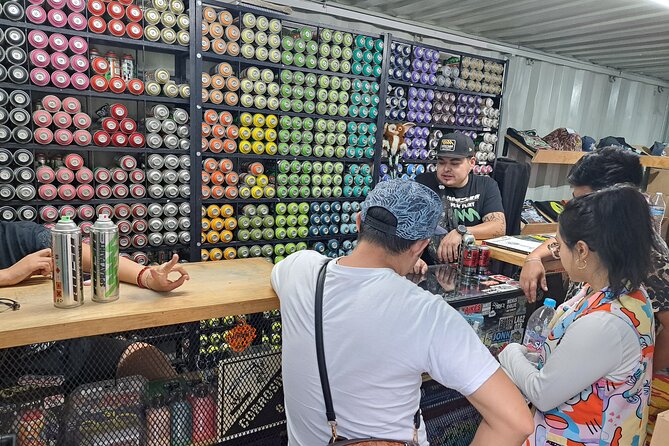
The final stop is Ex Fábrica MX, reached after about 40 minutes at the site. The building once operated as a flour factory in the 1940s. After years of abandonment, it was repurposed as an art district.
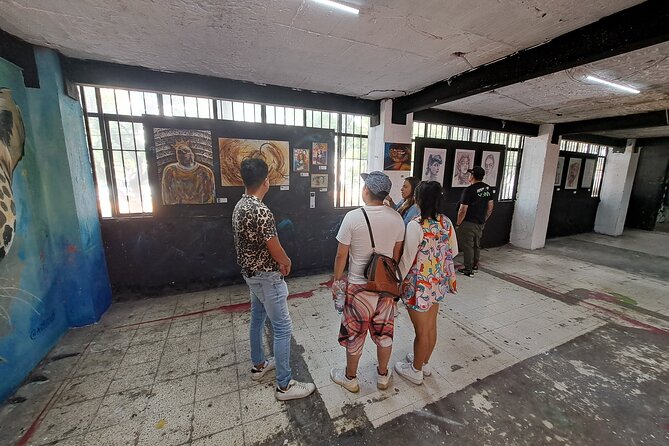
The old industrial setting gives the final stop a different mood from the first two. Instead of historic murals tied to a national political project, you find urban art, strong colors, large figures, and graffiti covering many surfaces.
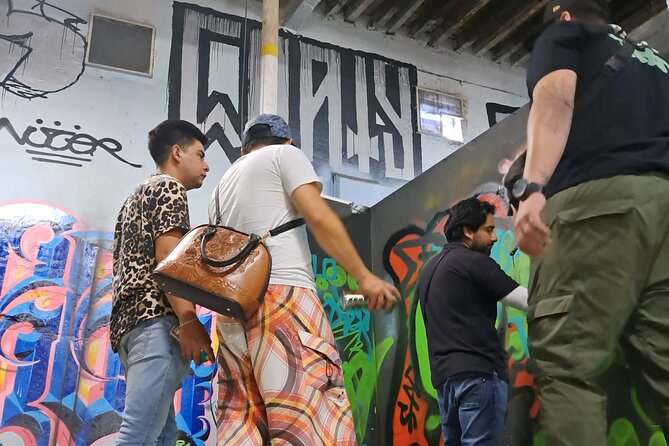
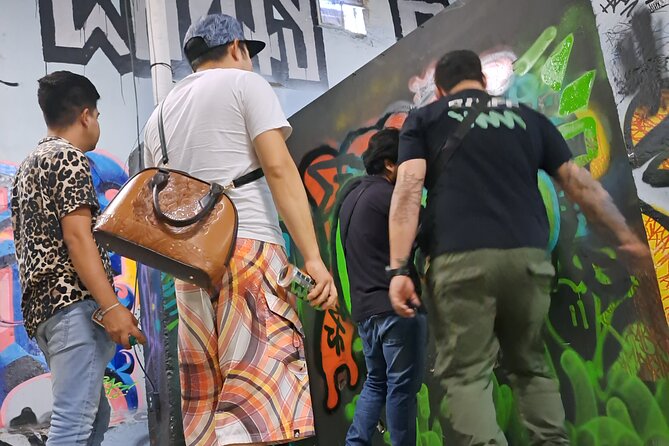
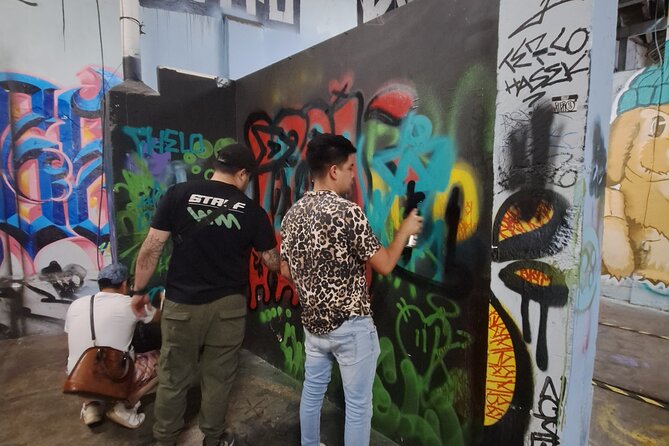
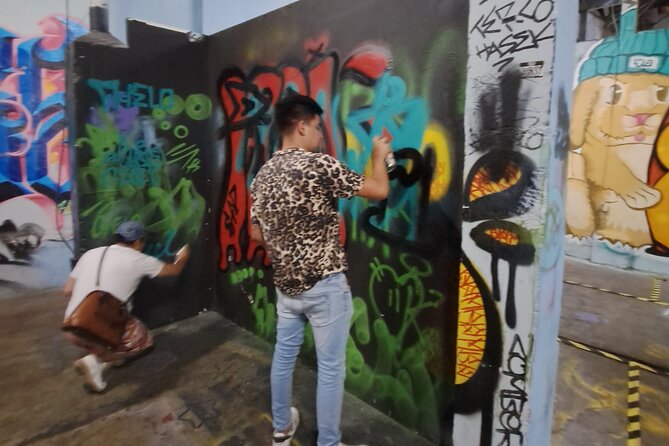
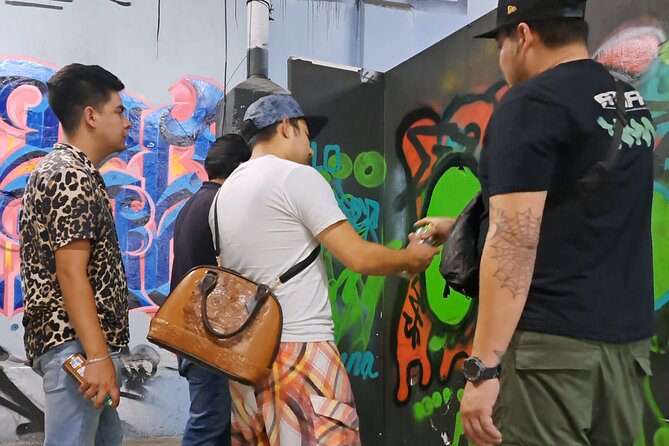
This is also where you can make your own graffiti. The chance to spray paint is a useful finish because it changes your role from observer to participant. You are not only hearing how artists use walls to communicate. You get a small taste of the physical act of working with a spray can.
The space also functions as a public area with bars and shops. That makes it a pleasant place to relax after the more academic parts of the route. You can finish the tour and stay in the area, though your food and drinks are your own responsibility.
Ex Fábrica MX is highly photogenic, but the value is not only the photo opportunity. It shows how an abandoned industrial building can be given a new public purpose through art. The connection to the older murals is not that the styles are identical. It is that both use public walls to reach people beyond traditional galleries.
The 40-minute stop may feel short if you want to inspect every painted surface or spend time at the shops. Still, it gives the tour a lively ending and breaks up the history with a hands-on activity.
How much value do you get for $71.36?
At $71.36 per person, this is more expensive than a basic street-art walk, but it includes a certified guide, admission to San Ildefonso, and public transportation. The main value is the interpretation, not simply the number of places visited.
You are paying for a route that links three different kinds of art spaces:
- A colonial school connected to the birth of Mexican muralism
- A public market filled with socially focused murals
- A repurposed factory devoted to contemporary graffiti and urban art
That sequence would be difficult to build efficiently on your own, especially if you do not know which murals are worth seeking out. The guide also supplies the political and artistic context that photographs alone cannot provide.
The price makes the most sense if you are genuinely interested in art, Mexican history, or city culture. It is less compelling if you only want a quick collection of colorful backdrops. You will spend several hours walking, listening, and using public transit, so the tour rewards curiosity more than passive sightseeing.
Because the group is limited to 12, you are also paying for a more personal format than a large coach tour. Jorge’s ability to explain symbolism and invite questions has been one of the strongest parts of the experience. Jaime has also led well-regarded tours with this provider, but the specific guide for your departure is not stated.
Who will enjoy this route most?
This tour works especially well for adults and older children who like visual art but do not want a formal lecture. An 11-year-old enjoyed the historical, architectural, and cultural explanations, and the graffiti activity gives younger participants something active to anticipate.
Families with teenagers may find the mix especially effective. San Ildefonso and the market provide serious art and history, while Ex Fábrica MX adds a contemporary setting and the chance to spray paint.
It also suits first-time visitors who want a stronger sense of Mexico City’s cultural development. You move from colonial architecture to post-revolutionary public art and then to current urban expression in one route.
You should think twice if you have limited mobility, dislike public transportation, or want to spend a full morning in one museum. The information says most people can participate and service animals are allowed, but it does not provide detailed accessibility information for every station, vehicle, or building.
Practical planning for the morning
Meet at the Mexico City Metropolitan Cathedral, at Plaza de la Constitución in Centro Histórico. Arrive ready to begin on foot and use public transportation during the route.
Wear walking shoes. Bring water, and plan to buy food before or after the tour since lunch, drinks, and snacks are not included. A phone with room for photographs is useful, especially if you want to remember artist signatures and compare the murals later.
The tour is offered in English and includes a mobile ticket. Confirmation is sent at booking. Free cancellation is available if you cancel at least 24 hours before the start time. Inside that window, the payment is not refunded, and changes are not accepted.
The route ends at Ex Fábrica MX, Primavera 106, Tacuba, Miguel Hidalgo. Since the ending point is different from the meeting point, check your plans for the afternoon before booking. The former factory is a good place to continue relaxing, but you should not assume that the tour returns you to the cathedral.
Should you book the Evolution of Muralism tour?
Book it if you want Mexico City’s murals explained rather than simply photographed. The combination of San Ildefonso, Abelardo L. Rodríguez Market, and Ex Fábrica MX gives you three periods and three settings, while the metro and bus ride keeps the experience connected to daily city life.
The strongest reason to choose it is the guide. Someone like Jorge, who can explain symbolism and political meaning without making the subject feel dry, turns the route into a lesson you can use at other museums and murals later.
Skip it if you prefer a slow, self-guided museum visit or do not want several hours of walking and public transportation. For families, art-minded visitors, and anyone curious about how Mexico City uses public walls to tell its story, the $71.36 price is fair, especially with the graffiti activity as a memorable finish.
FAQ
How long does the muralism and graffiti tour last?
The experience lasts approximately three and a half to four hours.
Where does the tour begin?
It begins at Mexico City’s Metropolitan Cathedral in Plaza de la Constitución, in the Centro Histórico.
Where does the tour end?
The tour ends at Ex Fábrica MX, located at Primavera 106 in Tacuba, Miguel Hidalgo.
Is admission included at San Ildefonso?
Yes. Admission to the Antiguo Colegio de San Ildefonso is included.
Does the tour use public transportation?
Yes. Public transportation is included, with the route using the metro and bus.
Can I cancel for a full refund?
Yes, if you cancel at least 24 hours before the experience start time. Cancellations or changes made less than 24 hours before the start time are not refunded or accepted.
Freshly painted around Mexico
- Xochimilco floating gardens, Coyoacan and UNAM murals★ 4.0 · 6 reviews
- UNAM: Murals & Revolution★ 4.9 · 8 reviews
- Street Art & Cemetery Cultural Tour – half day★ 5.0 · 3 reviews
- Graffitis & Munchies biketour Playa del Carmen★ 4.5 · 18 reviews
- Street Art Walk★ 4.5 · 7 reviews
- Diego Rivera’s murals, hidden treasures★ 5.0 · 21 reviews
- Tour Women Muralists : Strokes that resist Mexico City★ 5.0 · 7 reviews
- Private Street Art Tour in Rome★ 4.0 · 4 reviews
Mexico City Street Art Tours, compared.

Xochimilco, Coyoacan and Frida Kahlo with Optional Lunch
Read our review →
CDMX: Xochimilco, Coyoacan, Frida Kahlo Museum & Murals Tour
Read our review →
Mexico City; ART NACO : Murals & Street Art Bike Tour
Read our review →
Walking Tour – Impressive murals in Historical Center of Mexico City
Read our review →
La Catrina & Muralism: Diego Rivera’s Legacy & Frida Kahlo
Read our review →
Muralist Art Semi Private Walking Tour in Mexico City Downtown
Read our review →
Xochimilco floating gardens, Coyoacan and UNAM murals
Read our review →
Mexico City: Diego Rivera’s Murals Guided Walking Tour
Read our review →Browse the lists this tour appears in