
Review · LISBON
Lisbon Street Art – Private Guided Tour in a Electric Tuk Tuk
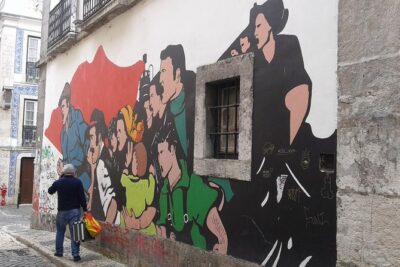
Lisbon’s street art is spread across steep hills, old neighborhoods, abandoned walls, and busy viewpoints. This private electric tuk-tuk tour lets you cover far more ground than you could on foot, while your guide explains the artists, political ideas, and local stories behind the work.
I like the easy access to pieces by Vhils and Bordalo II, plus the chance to see several different parts of Lisbon in one short outing. I also like the flexible format: guides such as David, Andre, Susana, Tiago, and Rumi Miguel have been praised for adjusting the route and adding background about the city.
The main drawback is time. Two hours goes quickly, and the tour is more of a fast, carefully chosen introduction than a full study of Lisbon’s street-art scene. At about $101.97 per person, it makes the most sense for a private group that values personal attention and efficient sightseeing.
Key points to know before booking
- A private electric tuk-tuk covers Lisbon’s steep streets and scattered murals without asking you to walk between every neighborhood.
- Major works include pieces by Vhils, Bordalo II, Shepard Fairey, Daniel Eime, Oze Arv, and André Saraiva.
- The tour links street art with Portuguese culture, including poet Sophia de Mello Breyner Andresen and fado singer Amália Rodrigues.
- Portas do Sol and Graça provide strong city views, so bring a camera and expect several photo stops.
- The guide can shape the outing around your interests, a useful feature if you have already seen Lisbon’s main monuments.
- Hotel pickup is available, and the activity returns to the starting point in Chiado.
Why a tuk-tuk works so well for Lisbon street art
Lisbon is not an easy city to cover on foot in a short time. Graça, São Vicente, Alfama, Chiado, and the viewpoints above the city are linked by steep roads, tight lanes, and uneven cobblestones. A tuk-tuk gives you a seat between stops and lets you see how quickly the character of the city changes.
The electric vehicle is also a sensible choice for this kind of tour. You are close to the streets and buildings, unlike in a large bus, but you do not need to spend the entire outing climbing hills. The open-sided design should give you a good view of walls and facades as you move through town, though you will want to pay attention when the guide points out a work from the road.
This is a private activity, so only your group participates. That matters here. Street art often needs a little explanation, and a private guide can pause when you have questions rather than following a fixed group schedule. It also gives you a better chance to request more murals, more viewpoints, or more local history.
The tour begins in Chiado, with hotel pickup available. The stated duration is about two hours, and the listed operating hours run daily from 9:30 a.m. to 7 p.m. The route ends back at the meeting point, which makes it convenient before dinner or after arriving in the city.
More Private Street Art Tours in Lisbon
- The Real Lisbon Street Art Private Guided Tour by Minivan
★ 4.8 · 49 reviews - Mon Ami Maravilha – Lisbon Street Art Private Tuk Tuk Tour
★ 5.0 · 42 reviews - The Real Lisbon Street Art Private Guided Tour by Minivan
★ 5.0 · 23 reviews
Graça begins with a portrait of Sophia
The first stop is the Miradouro da Graça, also known as the Sophia de Mello Breyner Andresen viewpoint. Here, you see a portrait of the Portuguese poet by Daniel Eime.
This is a smart opening stop because it shows that Lisbon’s public art is not only about graffiti lettering or large modern murals. The portrait connects street art to a major Portuguese cultural figure. Sophia de Mello Breyner Andresen lived from 1919 to 2004, won several prizes for her writing, and became closely linked with the Graça area. The viewpoint was later named for her.
You get around 10 minutes here. That is enough for a look, an explanation, and photographs, but not a long visit. The viewpoint also gives you a useful sense of Lisbon’s hills and rooftops. If you are beginning your stay with this tour, it works as a quick orientation to the city’s upper neighborhoods.
I would pay attention to the guide’s explanation of why the portrait belongs in this place. The value is not only the image itself. It is the connection between a neighborhood, a poet, and a public artwork that changes how you read the street around it.
Shepard Fairey and Vhils bring politics to the walls
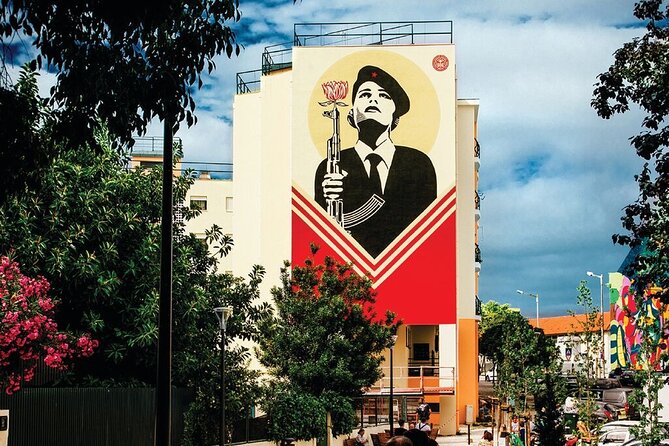
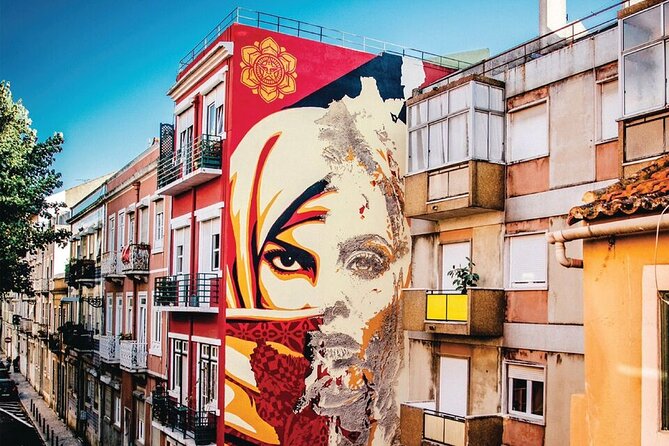
The next section focuses on collaborations and politically charged work connected with Shepard Fairey and Vhils. The route includes references to Fairey’s Carnation Revolution work, Once Upon a Time, Fuel, and Adapt, along with a Vhils and Shepard Fairey collaboration titled Universal Person Hood.
These names matter because Lisbon’s street art often carries ideas about freedom, identity, consumption, and public life. The Carnation Revolution, which ended Portugal’s dictatorship in 1974, is especially important to the city’s modern identity. A guide can give you the political setting that a quick photograph cannot.
You also stop to view Peace Guard, a large work by the American artist Shepard Fairey, also known as Obey Giant. The work is described as one of the closest things Lisbon street art has to an icon or landmark. Your guide asks you to turn around and position yourself for a clear view, a small instruction that can make a big difference when a mural is not directly in front of you.
Allow about 30 minutes for this part. That is the longest stop, and rightly so. You have more than one piece to see, plus the context linking Fairey’s graphic style with Lisbon artists and political themes.
The drawback is that street art changes. Murals can be covered, altered, or affected by weather and city works. The tour offers a useful current view of the scene, but you should not assume every image will look exactly the same years later.
Graça and São Vicente show different styles side by side
The route continues through Graça and São Vicente, with works by Oze Arv and André Saraiva. Oze Arv’s Alegria de um Caos Constante and André Saraiva’s azulejo mural give you a chance to compare very different approaches.
Saraiva’s work refers to the visual language of Portuguese azulejos, the painted ceramic tiles seen across Lisbon. That connection is particularly useful because it shows how contemporary artists borrow from older local design instead of working in isolation from the city around them.
The Oze Arv piece brings another tone, with its title referring to the joy of constant chaos. You may find that the guide’s explanation helps you notice details that are easy to miss from the back seat of a tuk-tuk. This is one reason I prefer a focused art tour to simply searching for murals on a map.
This stop lasts about 10 minutes. It is brief, but the short pause keeps the whole outing moving. If you want to spend several minutes studying every surface, tell your guide early. The private format gives you more room to shape the pace, though the two-hour limit still applies.
More Private Street Art Tours in Portugal
- Private Tuk Tuk of the Old Town Lisbon and Street Art Highlights
★ 5.0 · 20 reviews - Lisbon Street Art – Private Tuk Tuk Tour with pickup
★ 5.0 · 17 reviews - Lisbon: Private Tuk-Tuk Street Art Tour for 2,5 hours
★ 5.0 · 2 reviews
Bordalo II turns discarded material into a panda
At Rua São Tomé 76, you see Bordalo II’s panda. The work was created for an exhibition called Evilution, a made-up word tied to the artist’s continuing concerns about the environment and sustainability.
Bordalo II is known for making animals from discarded materials, and the panda gives you a clear example of how street art can carry an environmental message through the materials themselves. The subject is easy to recognize, but the construction rewards a closer look. Ask the guide to point out how the reused elements become part of the animal’s shape.
This is one of the tour’s strongest stops for families and for anyone who thinks street art means only paint on a wall. It also adds a practical topic to the route: waste. The art is not simply placed on the city. It is built from things the city has thrown away.
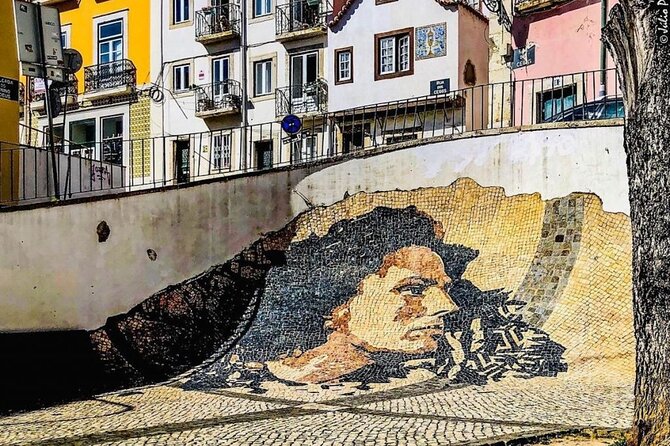
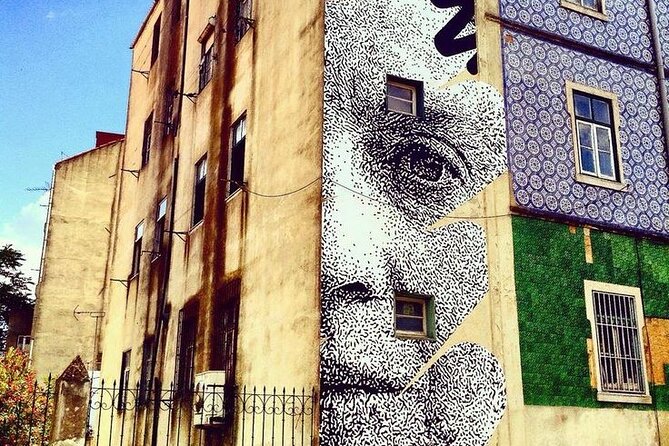
The tour then includes a Vhils work dedicated to Amália Rodrigues. This piece is made in the style of traditional Portuguese pavement and honors the famous fado singer, who lived from 1920 to 1999.
Vhils is especially associated with carved and weathered portraits that appear to emerge from the surface itself. Here, the use of Portuguese pavement creates a direct link to local streets and to Amália’s place in Portuguese music. You are not just looking at an artist’s style. You are seeing a meeting of contemporary public art, traditional materials, and fado culture.
The stop lasts about 15 minutes. Take time to look at the pavement details before stepping back for the full portrait. This is also a good point to ask your guide about Amália Rodrigues and fado if Portuguese music is part of your interest.
Portas do Sol adds the city view
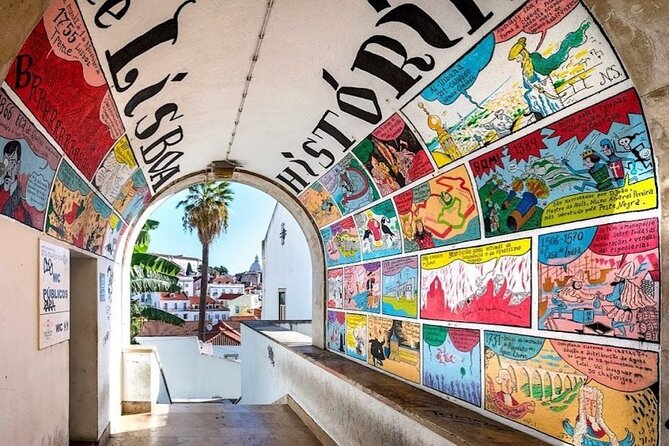
The final stop is the Portas do Sol viewpoint. Beneath the viewpoint, a small archway is painted with the history of Lisbon. The tour gives you about 10 minutes here.
This is a fitting finish. After seeing murals in side streets and older neighborhoods, you get a broader view of the city. Portas do Sol is a good place to connect the separate parts of the route: the hills, tiled buildings, historic quarters, and public art all become part of one picture.
The viewpoint is also useful if you are still getting your bearings. You can see why Lisbon’s hills shape daily life and why a tuk-tuk is practical for this type of sightseeing. Bring your camera, but remember that the stop is short. If the view is a priority, say so when the tour begins so your guide can help protect enough time for photographs.
What the guide adds to the experience
The quality of this tour depends heavily on the person driving and guiding. The available guide names include David, Andre, Susana, Tiago, and Rumi Miguel. Their backgrounds and styles may differ, but the experience is designed around personal commentary rather than a recorded narration.
David has been praised for combining street-art information with Lisbon history and for continuing to make the tour worthwhile in rainy weather. Andre has been singled out for friendly service and for tailoring the route to personal interests. Susana has been noted for taking groups into parts of the city different from the usual sightseeing route.
Tiago’s approach includes politics and cultural influences, and one three-hour booking led to arranging another Lisbon outing with him. Rumi Miguel is an artist himself, which may add a useful perspective when explaining how public art is made and read.
Do not expect every guide to give the same wording or follow the exact same emphasis. That is part of the appeal of a private tour, but it is also why you should tell the guide what interests you. Ask for more on Portuguese politics, recycled materials, fado, photography, or the techniques used by Vhils and Bordalo II.
Is $101.97 per person good value?
At about $101.97 per person, this is not a bargain sightseeing ride. You are paying for a private vehicle, a guide, hotel pickup if needed, and a route that combines several neighborhoods in about two hours.
The price makes better sense for a small group splitting the cost than for a solo visitor. It also offers more value if you have limited time, mobility concerns related to hills and cobblestones, or a strong interest in public art. You would likely see fewer works on your own during the same period, especially if you had to navigate between Graça, São Vicente, and Alfama.
For a visitor who enjoys walking slowly and researching murals independently, the price may feel high. Lisbon’s street art can also be encountered without a private vehicle. But finding specific works, understanding who made them, and reaching several areas efficiently takes planning.
I see this as a good early-trip activity for someone who wants to understand a side of Lisbon beyond monuments and viewpoints. It can also work late in a stay if you have already seen the main sights and want a different angle on the city.
Who should book this tour?
You are a good match if you want:
- A private experience instead of a large group
- A quick introduction to Lisbon’s street-art scene
- Help navigating steep streets and uneven paving
- Commentary on Portuguese culture and modern politics
- A flexible route shaped around your interests
- Viewpoints and photographs alongside the art
- A family-friendly outing where children remain with an adult
The tour may be less suitable if you want a long, technical study of each artist. Two hours is enough for a strong sampling, but not for every major work in Lisbon. It is also worth remembering that children must be accompanied by an adult.
Free cancellation is available when you cancel at least 24 hours before the start time. Cancellations made later, or changes made within that period, are not accepted for a refund.
My recommendation for making the call
I would book this tour if street art is a real interest, if you are visiting Lisbon for only a short time, or if the city’s hills make a walking route unappealing. The combination of Vhils, Bordalo II, Shepard Fairey, Daniel Eime, viewpoints, and local cultural figures gives the outing more substance than a simple mural hunt.
I would skip it if your main goal is a slow walking tour or if $101.97 per person feels too high for a two-hour activity. For everyone else, the private electric tuk-tuk is a practical way to see a scattered, changing side of Lisbon, with enough flexibility to make the route feel personal.
FAQ
How long is the Lisbon street-art tuk-tuk tour?
The tour lasts approximately two hours.
Where does the tour start?
The stated meeting point is in Chiado at 1200-445 Lisboa, Portugal.
Does the tour provide hotel pickup?
Yes. Hotel pickup is offered.
Where does the tour finish?
The activity ends back at the meeting point.
Is this a private tour?
Yes. Only your group participates in the activity.
Which language is offered?
The tour is offered in English.
Which artists can I expect to see?
The route includes work connected with Daniel Eime, Shepard Fairey, Vhils, Bordalo II, Oze Arv, and André Saraiva.
Can children join the tour?
Yes, but children must be accompanied by an adult.
More Street Art Tours by Tuk-Tuk and Taxi in Portugal
- Lisbon Street Art by Tuk Tuk : Graffiti & Murals Discovery
★ 4.3 · 15 reviews - Authentic Lisbon: 4h Tuk Tuk Tour of Lisbon and Belém Secret Gems
★ 5.0 · 11 reviews - Street Art Lisbon: Tuk Tuk Tour
★ 4.3 · 4 reviews - Chaparru`s Street Art Tuk Tuk Tour 3 H
★ 4.5 · 4 reviews
More Street Art Tours by Tuk-Tuk and Taxi in Lisbon
- Lisbon: Street Art Tuk Tuk Tour
★ 4.9 · 372 reviews - Lisbon: 3-Hour Street Art Tuk Tuk Tour
★ 4.8 · 86 reviews - Lisbon: Street Art TukTuk Tour
★ 4.8 · 37 reviews - Street Art – Tuk Tuk Tour
★ 5.0 · 17 reviews
Freshly painted around Lisbon
- Lisbon Street Art and Lookout Point Tour★ 5.0 · 17 reviews
- Private Tuk Tuk of the Old Town Lisbon and Street Art Highlights★ 5.0 · 20 reviews
- Street Art – Tuk Tuk Tour★ 5.0 · 17 reviews
- Street Art Tour by Tuk Tuk Joy★ 5.0 · 2 reviews
- Lisbon Street Art – Private Tuk Tuk Tour with pickup★ 5.0 · 17 reviews
- Lisbon Street Art Walk★ 5.0 · 17 reviews
- Discover Lisbon’s Best Street Art★ 5.0 · 6 reviews
- Street Art at Lisbon★ 5.0 · 2 reviews
Lisbon Street Art Tours, compared.

3-Hour Guided Street Art Walking Tour of Lisbon
Read our review →
Browse the lists this tour appears in