

Review · LISBON
Discover Lisbon’s Best Street Art
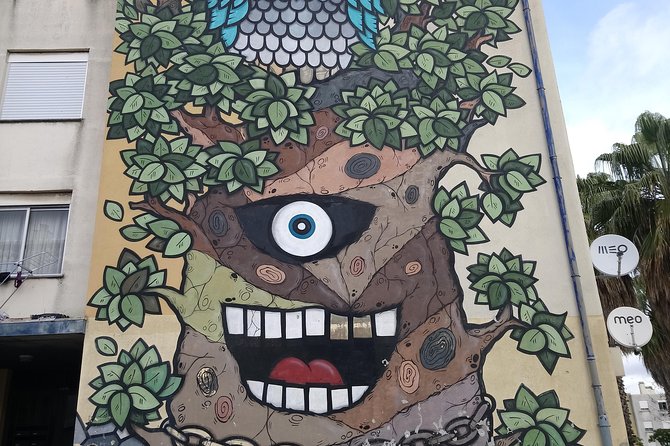
Lisbon’s street art is not confined to one pretty lane. This full-day outing crosses the city, from Alfama and Mouraria to the enormous open-air gallery at Quinta do Mocho. You’ll see major names such as Vhils, Bordalo II, Pichiavo, Obey Giant, and Eduardo Kobra, along with works tucked into places most visitors would miss.
I like the maximum group size of four, which gives the guides room to explain the artists and answer questions. I also like the mix of famous walls, fresh mural sites, and less obvious spots such as Chão do Loureiro. The main drawback is the length: three hours at Quinta do Mocho can feel heavy for children or anyone who tires in strong sun.
Key points to know
- Eight hours across Lisbon: This is a citywide art day, not a quick walk through one neighborhood.
- Small groups of four or fewer: You get a more personal outing with guides such as Igor or Catia.
- 110 murals at Quinta do Mocho: The final major stop is one of the tour’s biggest visual payoffs.
- Major artists on the route: Look for Vhils, Bordalo II, Pichiavo, Obey Giant, Mar, Utopia, and Eduardo Kobra.
- Historical streets meet modern art: Castelo, Alfama, and Mouraria provide an old Lisbon setting for new work.
- Weather matters: The tour requires good weather, and much of the day takes place outdoors.
Why this is more than a quick street art walk

Many Lisbon art walks focus on a few walls around the city center. This one takes a wider view. You begin near the Hard Rock Cafe on Avenida da Liberdade at 9:30 in the morning, then work through several districts before ending at Casa dos Bicos and the José Saramago Foundation.
That route matters. You see how street art changes from one part of Lisbon to another. In Castelo, Alfama, and Mouraria, murals appear beside old stone streets and steep lanes. Later, larger walls and purpose-built art projects take over. By the time you reach Quinta do Mocho, the art is no longer a surprise tucked between historic buildings. It has become the main feature of the neighborhood.
I would choose this tour if you want context as well as photographs. The guides, especially Igor and Catia, bring strong familiarity with Lisbon’s art scene. Igor is also a Lisbon native, and his tours include local history alongside the art. That combination helps you see the city as more than a backdrop for painted walls.
The group limit is unusually useful here. With four people or fewer, you can stop to ask why a particular artist uses stencils, portrait fragments, recycled materials, or large blocks of color. You are not simply following a guide from wall to wall.
More Street Art Tours around Lisbon:
- Lisbon: Street Art Tour
★ 4.9 · 1,324 reviews - Lisbon: Kickstart Street Art Walking Tour
★ 4.9 · 717 reviews - Lisbon: Street Art Tuk Tuk Tour
★ 4.9 · 372 reviews
Castelo, Alfama, and Mouraria: old Lisbon with new paint
The first two parts of the day take place around Castelo, Alfama, and Mouraria. They are listed as separate one-hour stops, but together they form the tour’s introduction to Lisbon’s street art scene.
Mouraria is a good place to begin because its narrow streets and older buildings create a strong contrast with modern murals. You can expect to see work placed directly into the daily fabric of the neighborhood rather than inside a formal gallery. The free admission here is helpful, but the real value comes from the explanation of what you are seeing.
The route includes work by Obey Giant and Vhils. Vhils is known for cutting, scraping, and removing parts of a wall to create portraits, so his work rewards a close look at the surface. Obey Giant brings a different visual language, with bold graphic forms that are easy to recognize from a distance.
The guide’s role is especially important in this section. Street art can disappear quickly under new paint, construction, or weather. A guide who follows Lisbon’s scene can point out what has changed and explain why one wall matters even if it looks less polished than a large commissioned mural.
These streets are also where the physical demands begin. Lisbon is hilly, and the opening section includes old districts rather than flat, purpose-built paths. Wear shoes that can handle uneven pavement, and keep some energy in reserve for the afternoon.
Chão do Loureiro and the city’s changing walls
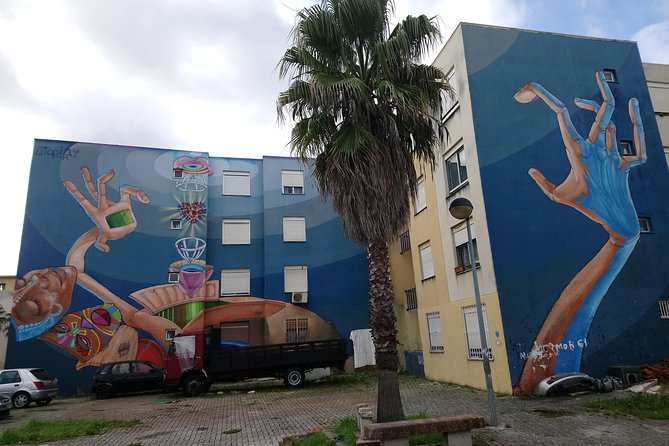
The tour also includes less obvious places, including the Chão do Loureiro galleries. This is one of the details that makes the outing different from simply walking around with a street art map.
You might find that the smaller or more tucked-away sites are as interesting as the famous walls. A large mural is easy to photograph, but a compact gallery or changing wall shows how flexible Lisbon’s art scene can be. The program also includes Amoreiras and Caracol da Graça, both associated with recent street art jam sessions.
A jam session brings artists together to work on walls around the same period. The result can feel less predictable than a single commissioned piece. Some sections may be polished and planned, while others show different hands, styles, and ideas meeting in one place.
This portion is useful for anyone who already knows the standard Lisbon stops, such as Calçada da Glória or the better-known areas around Belém. The tour reaches beyond the usual short list. You are not promised that every wall will still look exactly as expected, since outdoor art changes, but the guide can help you make sense of that constant change.
Santa Apolónia: Pichiavo and Bordalo II in 30 minutes
The Santa Apolónia stop lasts about 30 minutes, making it one of the shorter sections of the day. It focuses on work by Pichiavo and Bordalo II.
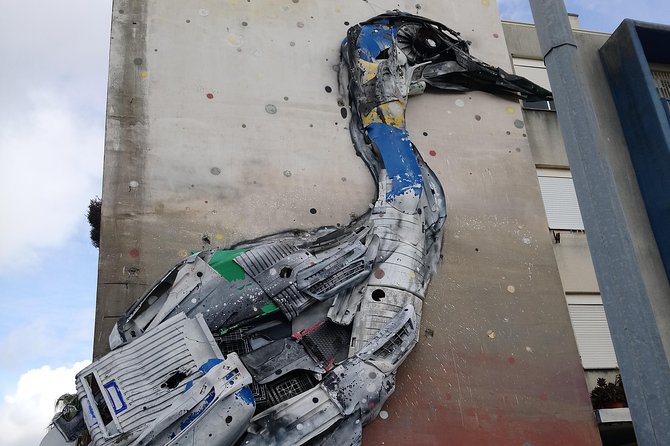
Pichiavo is associated with large-scale figures that draw on classical imagery and contemporary street art. Bordalo II is known for turning discarded materials into animal sculptures and wall pieces. His work often asks you to look twice, since the texture and shape of the materials form part of the image.
This stop gives the day some variety. You move from painted surfaces to art that may rely more heavily on construction, texture, and found objects. It also prevents the tour from becoming a long sequence of similar murals.
Thirty minutes is enough for an introduction, but it does not leave much time for lingering if the group has questions or the guide finds several nearby works. Think of Santa Apolónia as a focused stop rather than a full neighborhood exploration.
Same walls, a different way in:
- LISBON Street Art Tour
★ 5.0 · 371 reviews - 3-Hour Guided Street Art Walking Tour of Lisbon
★ 5.0 · 278 reviews - Lisbon Street Art Walking Tour
★ 5.0 · 141 reviews - Lisbon: 3-Hour Street Art Tuk Tuk Tour
★ 4.8 · 86 reviews
A newer hotspot and Eduardo Kobra’s giant mural
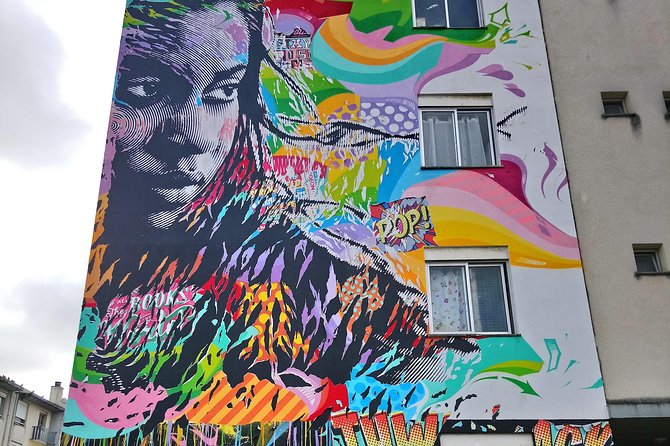
Another Lisbon stop lasts about an hour and centers on recent murals, including work by Eduardo Kobra. Kobra is widely associated with enormous, brightly patterned portraits, and his Lisbon mural is presented as the work of the Guinness World Record holder for the biggest mural in the world.
The exact appeal here is scale. After seeing art integrated into old streets and smaller galleries, you get a wall designed to be seen from farther away. This is a good moment to step back, take in the full composition, and then look for the smaller details that disappear when you stand too close.
The stop also helps explain why Lisbon has become such a major street art destination. The city supports both spontaneous-looking work and large public murals with a clear civic or artistic purpose. You get a better sense of that range here than you would from a single neighborhood walk.
Bring water and sun protection. The tour is outdoors, and one of the few practical criticisms of the day is that the heat can wear you down. A child who is happy at the start may not be as interested several hours later.
Quinta do Mocho: the three-hour centerpiece
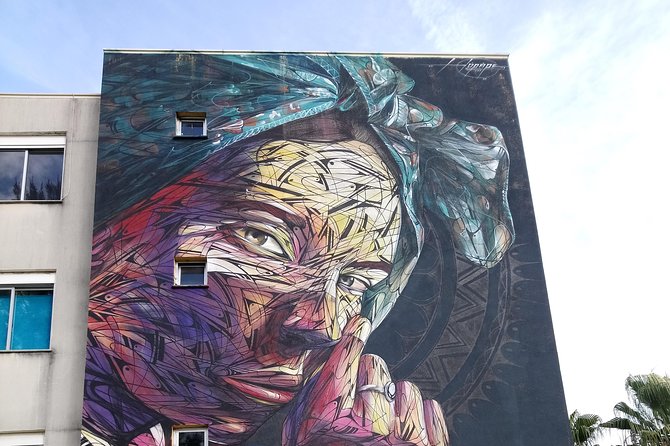
Quinta do Mocho is the largest and longest stop, taking about three hours. It is described as one of the world’s biggest outdoor street art galleries, with around 110 murals.
That number changes the way you approach the area. You are not just stopping for one famous photograph. You are walking through a neighborhood where art appears on a large scale and where several works can be compared side by side. Three hours gives the guide time to show more than the headline pieces.
This is likely to be the day’s main payoff for serious street art fans. You can look at how artists handle portraiture, lettering, color, social themes, and the shape of a building. You can also see how a collection of murals changes the feel of a neighborhood without turning it into a museum.
The length is both its strength and its main challenge. If you love street art, three hours gives you room to slow down. If you are traveling with a 10-year-old, or if the day is hot, it may feel too long. There is no need to pretend otherwise. This is an art-focused tour, not a general sightseeing day with a few murals added on.
Ask the guide to help you compare the pieces rather than trying to photograph everything. A camera can record 110 walls, but it cannot tell you which works are most important or how the styles differ. Igor’s local connections and Catia’s strong grasp of street art make that interpretation a key part of the price.
What the guides add to the day
The named guides associated with this experience are Igor and Catia. Igor is described as a Lisbon native with a strong connection to the local art scene, while Catia brings solid street art knowledge and a friendly approach.
That personal element matters because street art is not static. Walls are painted over, new work appears, and a neighborhood’s art program can change. A guide who follows those developments can give you a more current view than a printed guidebook.
Igor’s tours also connect art with Lisbon’s past, from the walled city area to the Saramago museum near the finishing point. That wider context is useful if you do not want your day to feel like a collection of disconnected photo stops.
The feedback on the guides is consistently warm, with particular praise for Igor’s passion, thoroughness, and genuine manner. The best way to interpret that is practical: you should expect a guide-led discussion, not a silent transfer between murals. If you prefer to wander alone and set your own pace, this may feel structured. If you want to understand the artists and locations, the format works well.
Is $134.13 a fair price?
At $134.13 per person, this is not a budget street art stroll. But it lasts about eight hours, covers much of Lisbon, and has a maximum of four participants. You are paying for time, range, specialist guidance, and a very small group rather than just access to walls.
The value is strongest if you would otherwise spend a full day trying to find the art yourself. Lisbon’s hills, scattered neighborhoods, and changing walls make independent searching possible but time-consuming. The guide takes care of the route and gives each area meaning.
Admission is free at the first two stops and at the newer Lisbon mural stop. Santa Apolónia and Quinta do Mocho are listed with admission included. No separate entry fee is presented as a major part of the cost, so the main expense is the guiding service and the full-day itinerary.
For a general Lisbon sightseeing trip, the price may be more than you need. For a serious street art fan, the small group and access to less obvious locations make it easier to justify. I would compare it with the cost of booking several shorter walks, plus the time you would spend finding the outlying neighborhoods.
Practical details before you book

You meet at the Hard Rock Cafe Lisboa, Avenida da Liberdade 2, at 9:30 a.m. The day ends at Casa dos Bicos and the José Saramago Foundation on Rua dos Bacalhoeiros 10. That ending places you near central Lisbon, which is useful for continuing into the Baixa or waterfront areas.
The experience uses a mobile ticket and is near public transportation. The maximum is four people, and most people can take part. The provided details do not specify a dedicated vehicle, meal, or hotel pickup, so you should not assume those are included.
Wear comfortable shoes and plan for a long day outside. The first sections involve historic neighborhoods, and the Quinta do Mocho portion alone lasts three hours. Good weather is required. If poor weather cancels the outing, you can choose a different date or receive a full refund.
You can cancel for a full refund up to 24 hours before the start time. Cancellations or changes made less than 24 hours ahead are not refunded or accepted.
Who should book this Lisbon art day?
I would book it if street art is one of your main reasons for visiting Lisbon, or if you have already seen the central sights and want a more local creative angle. It is also a strong choice for a couple or small group that values discussion and a flexible exchange with the guide.
Families should think carefully about the eight-hour schedule. A child who enjoys drawing or murals may have a great day, but the three-hour Quinta do Mocho section can be a lot, especially in hot weather.
You may want a shorter outing if you only have one free morning or prefer classic monuments. But if you want to see how Lisbon’s art scene reaches from old neighborhoods to vast outdoor galleries, this tour offers a much fuller picture than a standard central walk.
FAQ
How long is the street art tour?
The experience lasts approximately eight hours.
What time does the tour start?
It starts at 9:30 a.m.
Where does the tour begin?
The meeting point is the Hard Rock Cafe Lisboa at Avenida da Liberdade 2, Lisbon.
Where does the tour end?
It ends at Casa dos Bicos and the José Saramago Foundation at Rua dos Bacalhoeiros 10.
How many people can join the tour?
The tour has a maximum of four participants.
Which Lisbon neighborhoods are included?
The route includes Castelo, Alfama, Mouraria, Santa Apolónia, Quinta do Mocho, and other Lisbon mural locations.
Which artists might I see?
The tour includes work by Eduardo Kobra, Vhils, Bordalo II, Pichiavo, Obey Giant, Mar, and Utopia.
How many murals are at Quinta do Mocho?
Quinta do Mocho has about 110 murals.
Is the tour available with a mobile ticket?
Yes. A mobile ticket is available.
What happens if the weather is poor?
The experience requires good weather. If it is canceled because of poor weather, you can choose another date or receive a full refund.
Freshly painted around Lisbon
- Lisbon Street Art and Lookout Point Tour★ 5.0 · 17 reviews
- Street Art Tour by Tuk Tuk Joy★ 5.0 · 2 reviews
- Private Tuk Tuk of the Old Town Lisbon and Street Art Highlights★ 5.0 · 20 reviews
- Street Art – Tuk Tuk Tour★ 5.0 · 17 reviews
- Lisbon Street Art – Private Tuk Tuk Tour with pickup★ 5.0 · 17 reviews
- Lisbon Street Art Walk★ 5.0 · 17 reviews
- Street Art at Lisbon★ 5.0 · 2 reviews
- Authentic Lisbon: 4h Tuk Tuk Tour of Lisbon and Belém Secret Gems★ 5.0 · 11 reviews
Lisbon Street Art Tours, compared.

3-Hour Guided Street Art Walking Tour of Lisbon
Read our review →

Lisbon Street Art – Private Guided Tour in a Electric Tuk Tuk
Read our review →
Browse the lists this tour appears in