
Review · BOGOTA
Bogotá Street Art and Graffiti Tour 3 Hrs
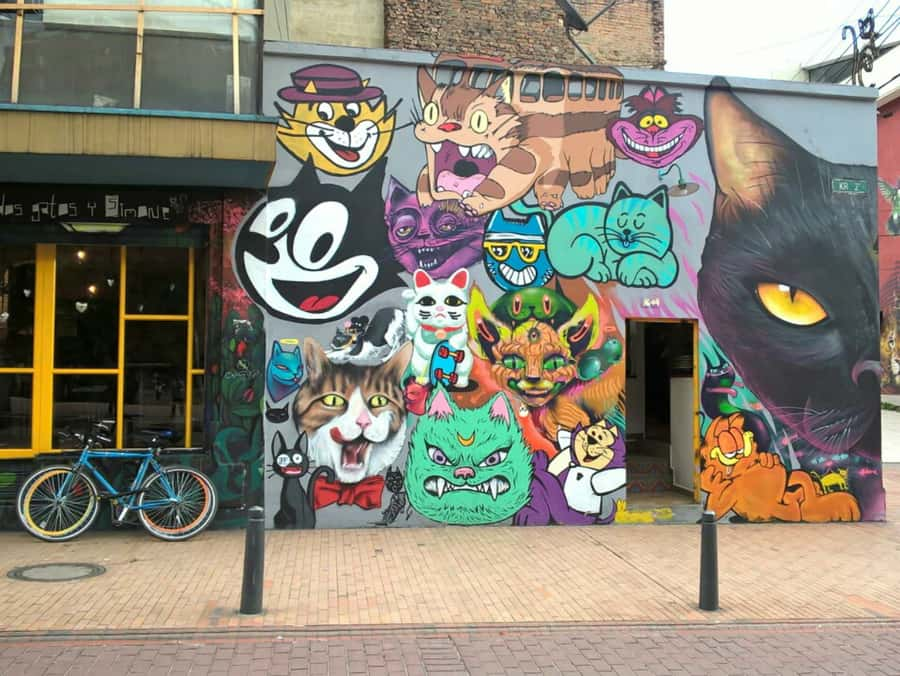
Bogotá’s graffiti is not simply decoration pasted onto old walls. It can carry political anger, personal grief, humor, advertising messages, or a burst of color meant to lift a difficult day. This three-hour private tour gives you a guide to that visual conversation, with hotel pickup and transport in a private vehicle.
I like the mix of street art and social history, and I like that the route reaches beyond painted walls to vintage shops, alternative stores, and local pubs. The main caution is timing: two hours are spent on the guided city tour, so this is a focused introduction rather than a full-day art crawl.
Key points at a glance
- Bogotá’s walls become the classroom: Learn how graffiti began, how it became a political tool, and why the city has accepted more commissioned work.
- Private transport keeps the tour easy: Hotel pickup and drop-off save you from arranging taxis around downtown.
- Art meets business: See how artists work with shop owners and companies to replace unwanted tagging with planned murals.
- Politics and memory matter: The guide explains how images can address Colombia’s difficult past and national politics.
- Local stops add texture: Browse vintage and alternative shops, then connect with the city at trendy pubs and other neighborhood spots.
- Camillo may bring an artist’s eye: When available, he speaks German and has personal experience with art, useful for readers who want more than a quick photo stop.
Why Bogotá’s graffiti deserves your time
I would book this tour for the stories behind the walls, not just for a collection of colorful photographs. Graffiti is one of the oldest ways people have used public space to express feelings, make political statements, and claim attention. In Bogotá, that old practice has taken on a newer role as part of the city’s public identity.
The guide helps you read details that can be easy to miss. A face may refer to a political issue. A symbol may point to a painful period in Colombia’s past. A commissioned mural may show how a business and an artist can share a wall without reducing the work to a simple advertisement.
That last point is important. The tour explains how businesses have hired artists to brighten their facades and discourage mindless tagging. You also learn how companies use graffiti-style campaigns to reach customers. This gives you a more balanced view of the art form. It is not presented as either pure rebellion or polished commercial work. You see how both can exist in the same city.
More Graffiti Tours in Colombia:
- Medellin: Comuna 13 Graffiti Tour, Cable Car & Street Food
★ 4.8 · 9,046 reviews - Medellín: Comuna 13 Tour with Snacks And Your Own Graffiti
★ 4.9 · 311 reviews - Bogotá: La Candelaria Graffiti & Urban Art Guided Tour
★ 4.7 · 250 reviews
Hotel pickup makes a short tour more useful
Your experience begins with pickup at your Bogotá hotel. A private vehicle then takes you toward the city center, and the same arrangement returns you to Bogotá at the end. For a three-hour activity, this matters. You do not spend part of the morning or afternoon finding the meeting point, negotiating transport, or trying to work out where the next stop lies.
The private format also gives the outing a more personal feel than a large group walk. The information describes this as a private group, with a professional guide and transport reserved for your party. That should appeal to couples, families, or small groups who want to ask questions as they go.
Still, keep your expectations sensible. Private transport is practical, but the art itself is experienced in the city center. The vehicle gets you into position, while the most useful part of the tour comes from looking closely, listening, and walking through the areas visited.
The first look at Bogotá’s city-center murals
The guided portion lasts about two hours within the full three-hour outing. The exact sequence of walls and stops is not fixed in the information provided, so you should think of this as a guided survey of central Bogotá rather than a guaranteed list of named murals.
The opening discussion covers the origin of the word graffiti and the place of writing and drawing in public spaces. That context helps you understand why the form remains powerful. A wall is visible to people who may never enter a gallery, buy a ticket, or seek out an exhibition. It reaches workers, shoppers, residents, and passersby on their normal routes.
You will then look at how Colombian artists have used public walls as a means of expression. Some work may brighten a street. Other pieces may offer commentary on politics or the nation’s traumatic past. The guide’s role is to connect image, place, and meaning without asking you to treat every wall as a masterpiece.
I appreciate that distinction. A good street-art tour should help you form your own opinion. You might admire one large painting, find another too commercial, and still learn something from both.
Legal commissions and the business of better walls
One of the more useful themes is the change from unauthorized tagging to commissioned work. In the tour’s explanation, property owners and businesses sometimes approve graffiti so that artists can create large, planned pieces. The result can be a more considered wall, with imagery, color, and messages chosen for a particular site.
This does not erase the tension between street art and commerce. It simply shows how the city has made room for both. A business may want a brighter facade or a memorable advertising campaign. An artist may want a public platform. The tour helps you see where those goals overlap and where they may not.
You also learn how advertising agencies use the style as a way to reach the market. That is a useful reminder that street art now operates in several worlds at once: political speech, neighborhood decoration, personal expression, and marketing.
If you enjoy urban design or public art, this part may be the most valuable. You are not only looking at what is painted. You are asking who commissioned it, who sees it, what it says, and why it appears on that particular building.
More Street Art Tours around Colombia:
- Medellín: Comuna 13 and Graffiti Guided Tour with a Local
★ 4.9 · 239 reviews - Historical Shared Tour Salsa, Graffiti & Resistance in Cali
★ 5.0 · 107 reviews - Medellín: Private Comuna 13 Street Art Tour
★ 4.8 · 88 reviews - Fun Graffiti Workshop: The Art of Aerosol and Color
★ 5.0 · 73 reviews
Politics, memory, and the people behind the images
Bogotá’s murals can also offer a way into Colombia’s difficult history. The experience explains how artists use images to comment on national politics and to respond to the suffering caused by the country’s traumatic past.
The details of each story depend on the guide and the works encountered that day. The supplied information does not name every mural or promise a fixed historical route, so I would not book this expecting a precise lecture on every period of Colombian history. Instead, expect a focused introduction to how public art can carry memory.
That approach suits the subject. Street art is often direct, emotional, and built for a specific place. A guide can point out how an artist makes a political idea visible or turns a painful subject into something that people can confront in daily life.
When Camillo is your guide, you may get an especially personal angle. He has an artistic side, speaks German, and brings plenty of information to the conversation. The German-language option is useful for German-speaking visitors who want to discuss the art without relying on a translation.
The guide is bilingual in Spanish and English, and the activity can be conducted in either language. Camillo’s German ability is a helpful detail, but it is best to confirm his availability rather than assume he will lead every departure.
Vintage shops and alternative stops
This is not a wall-to-wall art march. The route also includes vintage and alternative stores. These stops broaden the experience by showing you parts of the local scene connected to the same creative spirit.
The information does not identify specific shops or promise shopping time at each one. You might find a place suited to browsing, local style, or unusual gifts, but do not treat the tour as a dedicated retail excursion. The shops are part of the city-center experience, not the main product.
I like this change of pace. After studying several murals and discussing politics, a store gives you a different way to read the neighborhood. You see how independent businesses create their own identity and how alternative culture appears in clothing, objects, and storefronts as well as on walls.
If you want to buy something, ask your guide how much time is available before you start browsing. Three hours pass quickly, and the art discussion is the central reason to book.
Trendy pubs and a taste of local life
The itinerary also makes room for trendy pubs and other interesting places where you can connect with locals. No meal or drink is included, so budget separately if you decide to order something.
This is a social element rather than a formal food tour. The details of the pub stops are not fixed in the supplied information, and there is no promise of a particular drink, menu, or length of stay. Think of these visits as a chance to see where people gather and to ask the guide what is worth returning to later.
That flexibility can work in your favor. You may prefer a quick look and more time with the murals, or you may want to linger over a drink. Since this is a private group, you can ask about the balance, although the guide will still need to keep the tour moving.
What the $86 price means
At $86 per person, the tour costs more than a basic self-guided walk through central Bogotá. The value comes from the private structure, hotel pickup and drop-off, vehicle transport, bilingual guide, and interpretation of the art’s political and commercial setting.
For a solo visitor, the price may feel steep for three hours. For two or more people sharing a private experience, the cost becomes easier to justify, especially if you value door-to-door transport and the ability to ask questions without a large group.
You are also paying for access to context rather than just access to walls. You can photograph a mural for free, but you may not know whether it was commissioned, what issue it addresses, or how it fits into Bogotá’s changing relationship with graffiti. The guide supplies that missing layer.
Meals and drinks are not included. Keep a little extra money available if you plan to stop at a pub, and do not confuse the shop and pub visits with included purchases.
Comfort, timing, and practical preparation
The tour lasts three hours, with roughly two hours devoted to the guided city-center visit. Starting times depend on availability, so check the schedule before booking. Hotel pickup is included, but you should provide the correct Bogotá hotel details when arranging the activity.
Wear comfortable clothes. This is sensible even though the outing includes private transport, since you will be looking around central areas and may spend time outside the vehicle. Bring your passport or ID card, as requested in the practical instructions.
The activity is wheelchair accessible. That is a useful feature, but the exact access at every shop, pub, sidewalk, or mural stop is not described. If you use a wheelchair, confirm the route details before departure so the provider can address any specific needs.
Cancellation is free up to 24 hours before the activity for a full refund. You can also reserve now and pay later, which helps if your Bogotá schedule is still shifting.
Who will enjoy this Bogotá art tour
I would recommend it to you if you want a short, guided introduction to the city’s street-art culture and prefer private transport. It is also a good match for readers interested in politics, public space, advertising, local businesses, and the way art responds to painful history.
German-speaking visitors should ask about Camillo. His German and artistic background could make the discussion especially useful. English and Spanish are the stated tour languages, so those are the reliable choices when arranging the experience.
The tour may be less suitable if you want a long walking route, a fixed list of famous murals, or an art workshop where you create your own piece. It is also not a food tour, nightlife tour, or serious shopping excursion. Those elements appear as supporting stops around the main subject.
Families and mixed-interest groups may find the format helpful because the experience shifts between art, history, shopping, and local social spaces. Still, the political themes can be serious, and the guide may discuss Colombia’s traumatic past rather than offering only light sightseeing.
Should you book it?
Book this tour if you want to understand why Bogotá’s graffiti matters, not merely where to take a colorful photo. The combination of a bilingual guide, private vehicle, hotel pickup, local shops, and pub stops gives you a compact introduction to the city’s creative side.
At $86 per person, it is best value for a private party that wants ease and interpretation. Skip it if your main goal is to spend hours wandering on foot or to keep costs as low as possible. For everyone else, especially visitors curious about the link between art, business, politics, and memory, three focused hours can be time well spent.
FAQ
How long does the Bogotá street art tour last?
The activity lasts three hours. About two hours are listed for the guided tour in Bogotá.
Is hotel pickup included?
Yes. Pickup and drop-off at your hotel in Bogotá are included.
Is transportation provided?
Yes. You travel by private vehicle as part of the experience.
What languages are available?
The live tour guide speaks English and Spanish. Camillo, when available, also speaks German.
Is this a private group activity?
Yes. The experience is offered for a private group.
Are meals and drinks included?
No. Meals and drinks are not included in the price.
What should I bring?
Bring your passport or ID card and wear comfortable clothes.
Freshly painted around Colombia
- Comuna 13 Neighborhood & Street Art Private Tour★ 4.7 · 12 reviews
- Medellin: Graffiti Tour Comuna 13★ 4.1 · 14 reviews
- Medellín Comuna 13 local guides snacks and your own graffiti★ 4.9 · 13 reviews
- Comuna 13: Recorrido de Arte Urbano, Cultura y Resiliencia★ 5.0 · 3 reviews
- Graffiti Tour: a fascinating walk through a street art City★ 5.0 · 5 reviews
- Fun Graffiti Workshop: The Art of Aerosol and Color★ 5.0 · 3 reviews
- Comuna 13: Graffiti Tour with Tasting, Live Show, & Gallery★ 5.0 · 4 reviews
- Complete Tour in Comuna 13: Graffiti, History and Street Delights★ 5.0 · 11 reviews
Bogota Street Art Tours, compared.
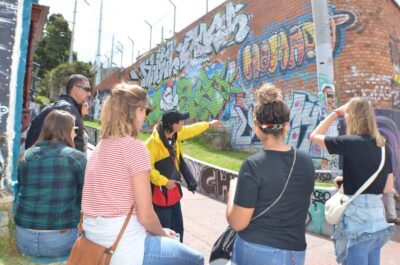
Bogotá: La Candelaria Graffiti & Urban Art Guided Tour
Read our review →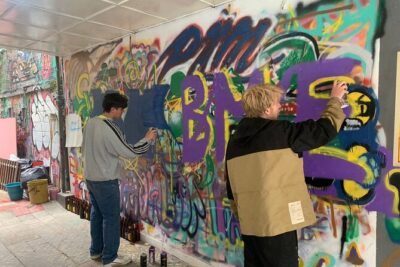
Fun Graffiti Workshop: The Art of Aerosol and Color
Read our review →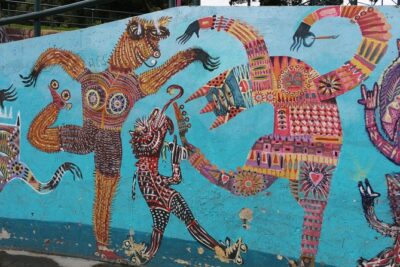
Graffiti Tour in La Candelaria Bogotá with Transportation
Read our review →
Bogotá: Graffiti Tour el mejor recorrido de arte urbano
Read our review →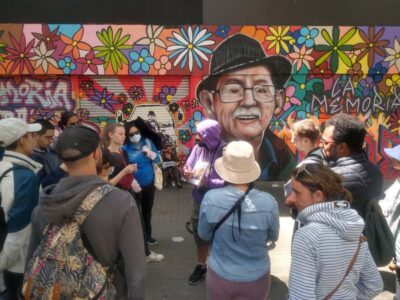
Graffiti Tour: a fascinating walk through a street art City
Read our review →Browse the lists this tour appears in