
Review · BOGOTA
Fun Graffiti Workshop: The Art of Aerosol and Color
The most memorable part of this Bogotá workshop is turning a blank wall into your own graffiti name. You begin at OCIO Gallery, look at Colombian prints and murals, then learn the basic moves before facing the wall with a spray can in hand. I like the small maximum group of 10 and the practical progression from dots and lines to a finished 3D tag.
I also like that the session treats graffiti as a working art form, not just a photo stop. Guides such as Diego and Cali, known professionally as TET, coach you through the process. The main caution is that can quality and group behavior can affect the session, so color choices may be limited and a family group with young children can change the pace.
Key points to know before you book
- You create a personal graffiti name: The workshop centers on a throwup 3D style, with planning on paper before you paint the wall.
- You start at OCIO Gallery: The gallery displays Colombian prints, clothing, murals, and photos connected with the workshop.
- You learn real spray-can control: Warm-up exercises cover dots, lines, and spirals before you attempt a tag.
- The session lasts about two hours: That gives you time for instruction, practice, sketching, and wall work without making this an all-day commitment.
- Materials are included: You get spray cans, graphic markers, thick paper, nozzles, and wall space.
- The group is capped at 10 people: That is a useful limit for a hands-on activity, though the experience can still depend on who shares your session.
Starting at OCIO Gallery in Bogotá
The workshop begins at OCIO Gallery, at Cra. 5 #26b-26 in Bogotá. This is more than a check-in point. You get a chance to look around before the spray cans come out, with Colombian prints, clothing designs, photographs, and other visual work on display.
I like this opening because it gives the workshop a little context. You are not simply handed a can and told to make a mess. The gallery helps you see that graphic art and street art can take many forms, from printed work to large wall pieces. If you arrive early, the gallery itself may be worth a look, and the area is close to La Perseverancia Market and places to eat.
The gallery visit is included, but food is not. Transportation is also not included, although the meeting point is near public transportation. Plan to make your own way there and allow enough time to find the entrance without rushing through the introduction.
The activity ends back at the same meeting point. That makes the workshop easy to fit into a day of exploring central Bogotá, especially if you want a creative stop rather than another standard sightseeing tour.
More Graffiti Workshops in Colombia:
- Fun Graffiti Workshop: The Art of Aerosol and Color
★ 5.0 · 3 reviews - NYC: Brooklyn Graffiti Workshop with Local Artist
★ 4.8 · 570 reviews - London: East End Street Art Tour and Spray Painting Workshop
★ 4.8 · 297 reviews
A friendly introduction to aerosol art
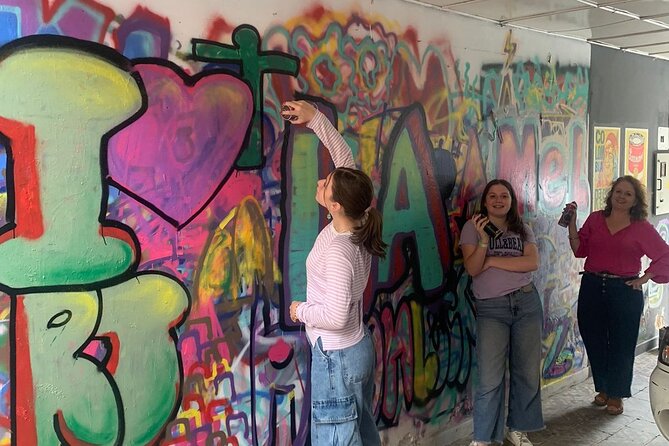
The instructor explains the goal at the start: invent a graffiti name and paint it in a throwup 3D style. A graffiti name is your chosen tag or artistic identity for the exercise. The 3D element gives the letters depth and helps the finished work read as a designed piece rather than a quick signature.
Before painting, the instructor shows the materials and explains how much of each supply is available. You are also asked for permission if photographs are taken. That small step matters, particularly if you prefer to focus on the work instead of appearing in pictures.
The workshop includes a short warm-up for your body and hands. It may sound playful, but it makes sense. Spray painting depends on loose arm movement, steady control, and a comfortable wrist. The instructor also shakes the cans and demonstrates how to handle them, including a creative presentation that mimics a giant signature in the air.
That demonstration gives you a visual sense of the movement needed. You are not expected to know how to use spray paint already. The session is built for beginners and people who have never held an aerosol can for art.
Learning dots, lines, and spirals before the wall
The first practical exercises are simple: dots, lines, and spirals. These drills show how the paint leaves the nozzle, how close to hold the can, and how speed changes the line. You also begin to understand why spray painting is not as easy as waving a can at a wall.
This part is especially useful for cautious beginners. You can make mistakes on paper before committing to the larger piece. The instructor offers pointers as you work, so you have a chance to correct your hand position and movement early.
You also learn about nozzles, which are included in the supplies. The choice and condition of a nozzle can affect the width and feel of your lines. That is one reason this workshop has more value than simply renting a can and trying to copy a mural on your own.
I would pay close attention during this stage. The exercises may look basic, but they prepare you for the letters. A clean dot, controlled line, or smooth curve becomes part of your final name.
Designing your graffiti name on thick paper
After the warm-up, you work out your tag on thick paper with graphic markers. This is where the class becomes personal. You choose a graffiti name, shape the letters, and think about how they will fit together in a throwup 3D style.
The paper stage also helps you make color decisions before you reach the wall. You can test the general look of the design and decide which parts need emphasis. The instructor helps you plan the project rather than leaving you to guess.
I like this balance between freedom and coaching. You are making your own piece, but you are not left alone with a blank wall. The guide can suggest ways to make the letters clearer, stronger, or more visually connected.
The process also explains why a two-hour session can feel full. Time goes into learning the tools, practicing control, sketching a design, choosing colors, and painting the final piece. The actual wall work is only one part of the experience.
More Graffiti Tours in Colombia:
- Medellin: Comuna 13 Graffiti Tour, Cable Car & Street Food
★ 4.8 · 9,046 reviews - Medellín: Comuna 13 Tour with Snacks And Your Own Graffiti
★ 4.9 · 311 reviews - Bogotá: La Candelaria Graffiti & Urban Art Guided Tour
★ 4.7 · 250 reviews - Medellín: Comuna 13 and Graffiti Guided Tour with a Local
★ 4.9 · 239 reviews
Choosing colors and taking your design to the wall
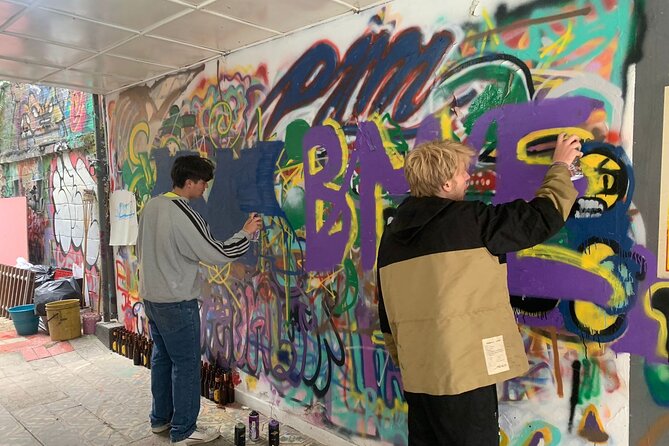
Once your paper plan is ready, you select colors and move to the wall space in the courtyard behind the gallery. The courtyard walls carry experiments and tags made by past participants, so you are working in a setting that already shows the workshop’s ongoing creative life.
This is the moment when the practice becomes real. A marker sketch is forgiving. A spray can on a wall is less so. You need to control the distance, movement, and amount of paint while keeping the letters readable.
The instructor coaches you as you work. That guidance can help shape the finished tag so it has more impact. You may begin with a simple idea and discover that small changes to a letter, outline, or shadow make the whole design more convincing.
The wall space is included, which is a practical benefit. You do not need to search for a legal surface or worry about carrying supplies through Bogotá. The work takes place within the workshop’s own space, and the surrounding examples give you visual prompts without requiring you to imitate them.
What the guides add to the session
The workshop has been led by Diego and by the artist known professionally as TET, whose name is Cali. The supplied details do not establish which guide will lead every departure, so I would not book expecting one specific person unless the provider confirms it.
What matters most is the teaching approach described in the session: explanation first, simple exercises next, then planning and individual coaching. That order makes the class approachable even if you have no art training.
Cali, known as TET, is connected with work on walls around Bogotá. That gives the workshop a useful link to the city’s graffiti culture. You are not only learning a generic craft technique. You are receiving guidance from someone associated with the local scene.
Diego has also been described as interactive with children during a family session. That suggests the workshop can suit families, though the age and behavior of the children in your particular group will shape the atmosphere.
The group size and the family question
The maximum group size is 10. For a hands-on class, that is a sensible limit. You need access to materials, wall space, and instructor feedback, and a smaller group gives you a better chance to ask questions.
Still, a small group is not the same as a quiet adult class. One session included two families traveling together, with several children about eight or younger. The children were energetic, some adults took less part, and the atmosphere became distracting for people who wanted a focused art lesson.
That was not a failure of the instructor. It was a reminder that group activities depend on the mix of people who book them. If you want a calm, concentrated workshop, ask about the expected group makeup when you reserve, though no operator can fully control who joins.
For families, the same detail can be a benefit. The workshop has worked well as a family activity, and the guide can interact with children while they learn about graffiti and make art. Adults should set expectations in advance, since a two-hour spray-paint session still requires patience and some attention.
The issue with spray cans and color choices
The most specific drawback concerns the materials. In one session, too many cans were empty or nearly empty. That limited color selection and created frustration during the painting stage.
This matters because color is part of the finished design. If you have planned a certain contrast or want to use several shades, a weak or empty can can force you to change course. You may need to simplify your idea or work with whatever colors still spray properly.
I would treat this as a practical risk, not a reason to dismiss the workshop. Supplies are included, which keeps the activity convenient, and the operator may have addressed the problem. Still, if your project depends on a particular color, it is sensible to ask about supply levels on the day.
The issue also shows why the instructor’s help matters. A good guide can adjust the plan, make the best use of available paint, and help the piece work even when the original color scheme changes.
Is $58 a fair price?
At $58 per person, this is not the cheapest way to spend two hours in Bogotá. You are paying for instruction, spray cans, markers, paper, nozzle options, wall space, the gallery setting, and the chance to create a finished piece rather than only watch someone else paint.
I see the strongest value if you want an active experience. You are learning a technique, making a personal design, and using materials that would take time and money to gather on your own. The included gallery visit adds a visual introduction to Colombian graphic art.
The value is weaker if you mainly want to see Bogotá’s famous street art from the outside. This is not a walking tour of the city’s murals, and it does not include transport, food, or tips. You spend the time making art at one location rather than touring several neighborhoods.
For someone who enjoys hands-on activities, the price is reasonable. For a person who prefers sightseeing with a guide and little participation, I would put the money toward a mural walk instead.
Who will enjoy this Bogotá graffiti workshop?
I would recommend it to:
- First-time spray-paint users who want clear instruction
- Solo visitors looking for a social activity with a creative result
- Couples who want to make something together
- Families whose children can follow a two-hour art session
- Art students or enthusiasts curious about Bogotá’s graffiti practice
- Anyone who likes souvenirs with a personal touch rather than a shop-bought object
I would be more cautious if you need a tightly controlled, quiet class or a specific set of colors. You should also know that the session is about making your own tag, not producing a polished mural worthy of a gallery wall.
Most people can participate, and the meeting point is near public transportation. The activity is about two hours long, so it fits well between other plans. I would avoid scheduling it too tightly around a meal or another timed booking, since the creative process is more enjoyable when you are not watching the clock.
Booking, cancellation, and useful planning details
Confirmation is sent within 48 hours of booking, subject to availability. The activity is often reserved about 34 days ahead, so I would book earlier if your Bogotá dates are fixed.
You can cancel for a full refund up to 24 hours before the start time. Cancellations or changes made inside that period are not refunded or accepted. Cut-off times use Bogotá’s local time.
The session requires a minimum number of participants. If that minimum is not reached and the activity is canceled, you are offered another date or experience, or a full refund.
Tips, food, and transportation are not included. The provider supplies the art materials, so you do not need to bring spray paint or paper. Since photographs may be taken with your consent, decide before the workshop whether you are comfortable being included.
Should you book it?
I would book this workshop if you want to do more than look at Bogotá’s graffiti. The best parts are the clear beginner progression, the small group cap, the OCIO Gallery setting, and the chance to leave with a design you created yourself.
I would skip it if your main goal is a citywide mural tour, or if you would be disappointed by a limited color selection. Families should expect a lively session, while adults seeking a focused class may want to ask about the group before booking.
For most first-time participants, $58 buys a genuine, practical introduction to aerosol art rather than a passive demonstration. Go in ready to experiment, accept that the paint may not behave perfectly, and you will get the most from the two hours.
FAQ
How long does the graffiti workshop last?
The workshop lasts approximately two hours.
Where does the activity begin?
It begins at OCIO Gallery, Cra. 5 #26b-26, Bogotá, Colombia.
Where does the activity end?
The activity ends back at the meeting point at OCIO Gallery.
What is the main goal of the workshop?
You create a graffiti name and paint it in a throwup 3D style.
Do I need previous spray-paint experience?
No. The workshop is designed for beginners and people with no previous spray-paint experience.
What materials are included?
Spray cans, graphic markers, nozzles, thick paper, and wall space are included.
Is a visit to the gallery included?
Yes. The experience includes a visit to the cultural house with murals and photographs connected with the activity.
Is transportation included?
No. Transportation is not included, though the meeting point is near public transportation.
How many people can join the workshop?
The maximum group size is 10 participants.
Can I cancel for a full refund?
Yes. You can cancel at least 24 hours before the start time for a full refund. Cancellations or changes made less than 24 hours before the start time are not accepted for a refund.
Freshly painted around Colombia
- Comuna 13 Neighborhood & Street Art Private Tour★ 4.7 · 12 reviews
- Medellin: Graffiti Tour Comuna 13★ 4.1 · 14 reviews
- Medellín Comuna 13 local guides snacks and your own graffiti★ 4.9 · 13 reviews
- Comuna 13: Recorrido de Arte Urbano, Cultura y Resiliencia★ 5.0 · 3 reviews
- Fun Graffiti Workshop: The Art of Aerosol and Color★ 5.0 · 3 reviews
- Graffiti Tour: a fascinating walk through a street art City★ 5.0 · 5 reviews
- Comuna 13: Graffiti Tour with Tasting, Live Show, & Gallery★ 5.0 · 4 reviews
- Complete Tour in Comuna 13: Graffiti, History and Street Delights★ 5.0 · 11 reviews
Bogota Street Art Tours, compared.
Bogotá: La Candelaria Graffiti & Urban Art Guided Tour
Read our review →
Graffiti Tour in La Candelaria Bogotá with Transportation
Read our review →
Bogotá: Graffiti Tour el mejor recorrido de arte urbano
Read our review →
Graffiti Tour: a fascinating walk through a street art City
Read our review →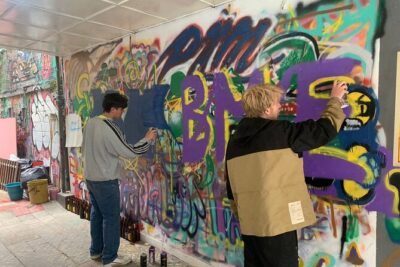
Browse the lists this tour appears in