
Review · MEXICO CITY
Tour history of Muralism in Mexico
Mexico City’s mural tradition makes the most sense when you see it in the places where it took shape. This 3-hour-30-minute tour links four important mural sites, beginning at the former Colegio de San Ildefonso and ending at Palacio de Bellas Artes, with a market stop that adds everyday life to the art lesson.
I like the route for two clear reasons: admission is included, and the stops show more than famous Diego Rivera panels. You also hear about the Greenwood sisters, among the first women to paint murals in Mexico, while Abelardo L. Rodríguez Market gives the tour a working-city setting.
The main consideration is pace. Three and a half hours covers several venues, and the maximum group size is 35 people. If you want long, quiet time with every mural, you may prefer to visit one museum on your own. If you want a guided introduction with a clear route, this is a useful choice.
Key points about the muralism tour
- San Ildefonso opens the story: Begin inside a former Jesuit school with colonial architecture and murals by Diego Rivera, José Clemente Orozco, and David Alfaro Siqueiros.
- The market stop adds daily life: Abelardo L. Rodríguez Market shows how mural art reached a working public place, not only formal museums.
- Women artists get attention: The guide explains the Greenwood sisters’ role as some of the first women to paint in Mexico.
- Diego Rivera receives a full stop: At the Secretariat of Public Education, you see a large body of Rivera’s murals and learn how the project developed.
- The route finishes at Bellas Artes: The tour ends by explaining the murals inside Mexico City’s best-known fine-arts venue.
- The format is practical: English guiding, mobile tickets, included entries, and free cancellation up to 24 hours before departure make planning simple.
Why Mexico City’s murals work best as a route
Mexico’s mural movement is not confined to one gallery wall. It appears in former schools, public buildings, markets, and major cultural venues. That is the central idea behind this tour: you move from an old educational institution to a market, then to the Secretariat of Public Education, before finishing at Bellas Artes.
I like this approach because each stop gives muralism a different setting. A museum can make art feel separate from daily life. A public market or government school building shows how murals were meant to meet people where they lived, worked, and studied.
You will not get a full academic history of every artist in three and a half hours. You will get a guided framework for reading the city’s murals and understanding why public walls mattered. That makes the experience a good first step before later visits to Mexico City’s larger museums and cultural sites.
The tour is offered in English and uses a mobile ticket. The price is $59.57 per person, with admission included. That is not the cheapest way to see murals in Mexico City, but the price covers entry to several places and gives you a guide to connect them. The value depends on how much explanation you want. If you already know Rivera, Orozco, and Siqueiros well, you may find the cost harder to justify. If the artists are new to you, the structure can save time and help you notice details you might otherwise pass by.
More Muralism Tours around Mexico:
- Xochimilco, Coyoacan and Frida Kahlo with Optional Lunch
★ 4.5 · 7,320 reviews - CDMX: Xochimilco, Coyoacan, Frida Kahlo Museum & Murals Tour
★ 4.4 · 3,025 reviews - La Catrina & Muralism: Diego Rivera’s Legacy & Frida Kahlo
★ 4.5 · 197 reviews
San Ildefonso: a school turned cultural landmark
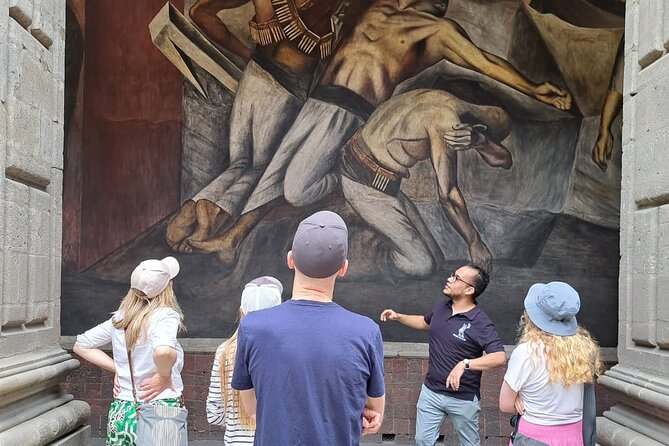
The tour begins at the former Colegio de San Ildefonso, at Justo Sierra 16 in the Historic Center. The building began as a Jesuit school in the 16th century, and its colonial architecture sets the tone before you even reach the murals.
This is a strong opening stop because the building itself carries several layers of Mexico City’s past. It was first tied to Jesuit education, and today it functions as a museum and temporary exhibition space. Art, education, architecture, and public culture meet in one place.
The mural collection includes work by Diego Rivera, José Clemente Orozco, and David Alfaro Siqueiros. Those names alone make the stop important, but the guide’s explanation is what helps you compare their approaches. Rather than treating muralism as one single style, you can begin to see it as a broad movement shaped by different artists and public goals.
You have about 35 minutes here, with admission included. That is enough for an introduction and selected works, but not enough to inspect every corner at a slow pace. I suggest arriving ready to listen first, then using any spare moments to look closely at the walls and the building details.
The stop also gives you a useful question for the rest of the tour: why place large-scale art in an institution connected to learning? You will carry that question into the market and the Secretariat of Public Education, where the relationship between art and public life becomes even clearer.
Abelardo L. Rodríguez Market and the public wall
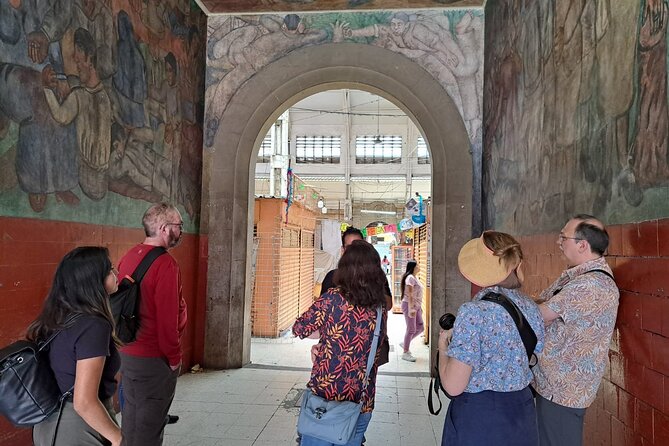
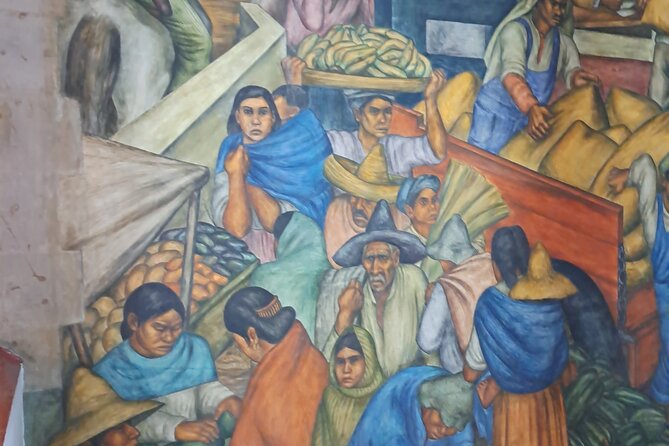
The second stop is Abelardo L. Rodríguez Market, another 35-minute visit. The setting changes sharply from a former school and museum to a market where people begin their day with practical concerns.
That change is one of the best features of the route. You are not looking at muralism only as a formal art movement. You are also seeing the kind of public setting where murals could speak to working people. The tour explains the pictorial project connected with the market and introduces several artists involved in it.
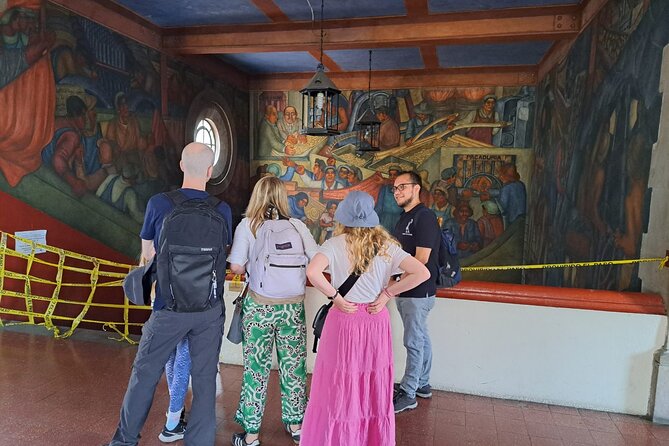
The Greenwood sisters receive special attention here. The tour presents them as the first women to paint in Mexico, an important detail that is easy to miss when the story centers only on the best-known male muralists. Their inclusion broadens the subject and gives you a better sense of how many artists contributed to Mexico’s public art projects.
The market stop may feel less polished than the museum venues. That is part of its value, but it also means you should expect a more active, everyday setting rather than a quiet gallery. The information provided does not promise a private viewing area or an empty market, so keep your expectations practical.
You get 35 minutes, which is enough to hear the explanation and take in the murals, but not a long period for independent study. Pay attention to how the setting affects the art. In a market, a mural becomes part of the flow of ordinary life. That is a different experience from standing in front of a framed painting.
This stop also gives the tour its most human scale. You hear about artists who worked on a shared project, see art in a place used by local people, and consider how public painting can carry social ideas beyond the walls of a museum.
The Secretariat of Public Education and Rivera’s long project
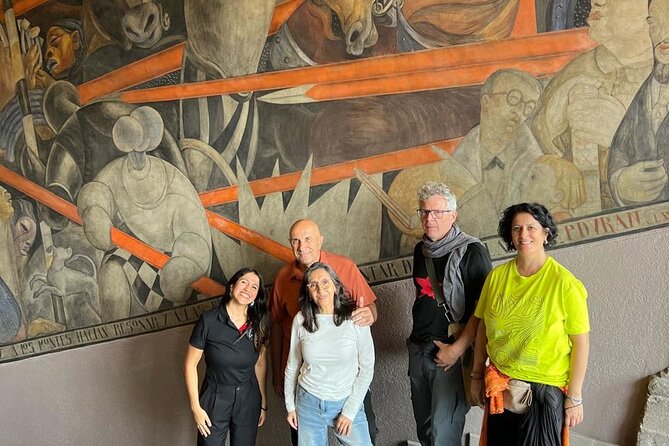
The third stop is the Murales de Diego Rivera at the Secretariat of Public Education. At 45 minutes, it is the longest scheduled stop, and that makes sense. This building holds a substantial group of Rivera’s murals and is described as a museum of muralism today.
Here, the focus shifts toward Rivera and the history of the larger project. You will learn how the work developed and see many of his murals in one place. A single Rivera mural can be striking, but a group of murals lets you notice repeated themes, visual choices, and changes from one wall to the next.
This is where the tour’s earlier stops begin to connect. San Ildefonso shows muralism in an educational setting with several leading artists. The market shows a public project linked to working life. The Secretariat brings you into a major Rivera installation where the scale and purpose of the project become easier to understand.
Forty-five minutes is still a guided visit, not an unlimited museum session. If you like to read every label or study every figure, you may want to return later. For a first visit, though, the longer time allocation gives the guide room to explain the project instead of rushing through a few famous images.
Rivera’s work can be visually crowded. Figures, symbols, historical references, and political ideas may compete for your attention. A good guide helps you know where to look first. The guide on this experience is described as prompt, personable, and well informed, qualities that matter when a tour asks you to take in a large number of images in a short period.
More history behind the walls around Mexico:
- History and Murals: Walking Tour Guadalajara
★ 5.0 · 237 reviews - Walking Tour – Impressive murals in Historical Center of Mexico City
★ 5.0 · 224 reviews - Private Walking Tour Guadalajara History and Murals with Guide
★ 5.0 · 6 reviews - Mexico City: Historic Center Walking Tour with Murals
★ 5.0 · 6 reviews
Bellas Artes: ending with Mexico City’s grand mural setting
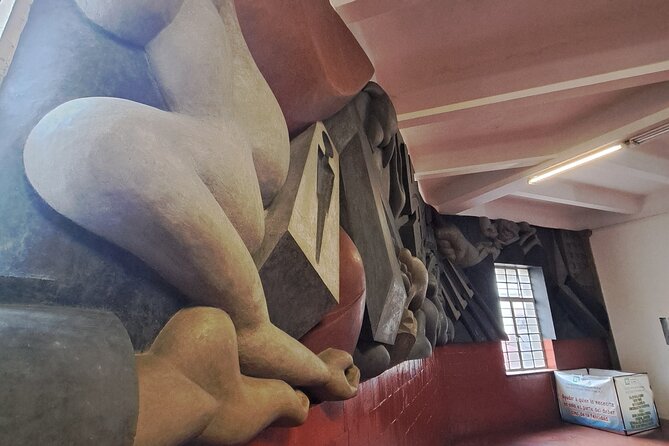
The tour ends at Palacio de Bellas Artes on Avenida Juárez. The experience finishes by explaining the murals at the Fine Arts Palace, so the final stop acts as a closing lesson rather than a separate full itinerary stop with a stated duration.
Bellas Artes is a fitting endpoint. After seeing murals in a former school, a market, and the Secretariat of Public Education, you arrive at one of Mexico City’s most prominent cultural buildings. The ending lets the guide bring the subject back to the city’s major artistic institutions.
The information provided does not specify which individual murals are discussed at Bellas Artes or how long the explanation lasts. Treat it as a final orientation, not as a full museum visit. If you want more time inside the palace, plan that separately after the tour, provided your schedule allows.
The endpoint is useful for practical sightseeing, too. You finish in the Historic Center near other major sights, rather than returning to the starting point. That one-way design can save backtracking, but you should plan your day around ending at Bellas Artes.
Timing, group size, and what the price covers
The total duration is approximately three hours and thirty minutes. The scheduled visits account for 35 minutes at San Ildefonso, 35 minutes at Abelardo L. Rodríguez Market, and 45 minutes at the Secretariat of Public Education. The remaining time covers movement between stops and the explanation at Bellas Artes.
The maximum group size is 35 people. That is large enough to feel like a group tour, so you should not expect the intimacy of a private guide. The upside is a lower cost than many private art tours. The possible downside is that it may be harder to hear or see clearly if the group gathers tightly around a mural.
The tour costs $59.57 per person. Entries are included, while tips and lunch are not. Since the route uses several cultural venues, included admission makes the price easier to assess. You are paying not only to enter but also for a guide to connect the sites and explain the artists.
Food is not included, so plan for lunch separately. The supplied information does not specify a meal break, and the three-and-a-half-hour schedule may leave little time for one during the tour. Eat beforehand or arrange your meal after the finish, rather than counting on lunch as part of the experience.
The tour is booked an average of 26 days ahead, which suggests you should not leave it until the last moment if the date matters to you. Confirmation arrives when you book, and the mobile ticket makes the entry process simple.
Who will get the most from this experience
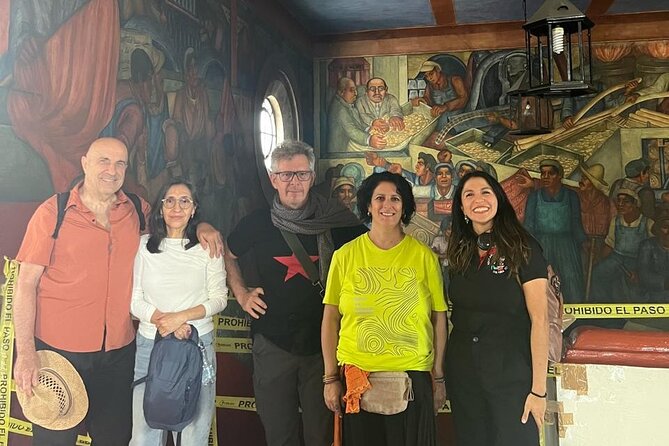
I would choose this tour if you want a clear introduction to Mexican muralism and prefer a guide to independent research. It suits first-time visitors to Mexico City, art lovers who want historical context, and anyone curious about how public art works outside a traditional gallery.
It is also a good choice if you want to see more than Rivera. The route includes Rivera, Orozco, and Siqueiros at San Ildefonso, the Greenwood sisters at Abelardo L. Rodríguez Market, and a major Rivera project at the Secretariat of Public Education. That range gives the subject more balance.
You may want another plan if you need a slow, highly detailed art study. The tour has several stops, a group limit of 35, and fixed visit lengths. People with limited stamina should also note that the experience lasts about three and a half hours and takes place across several central locations, though the information does not provide a detailed accessibility assessment.
Service animals are allowed, and the tour is near public transportation. Most people can participate. Those practical points make it easier to fit into a larger Mexico City itinerary, but the exact transport between locations is not specified, so check the meeting details and allow time to reach Justo Sierra 16.
Booking, cancellation, and simple planning advice
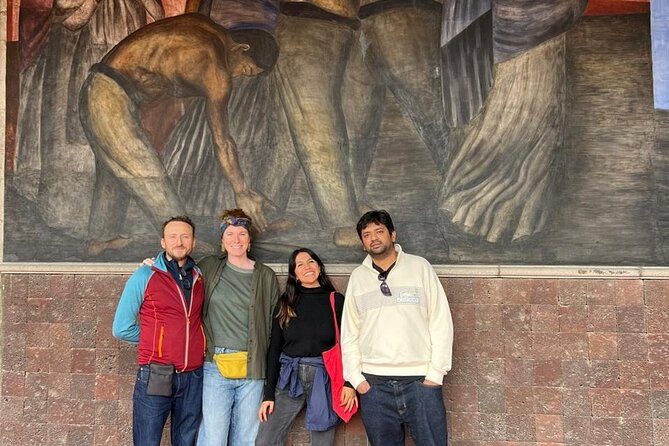
The meeting point is the former College of San Ildefonso, Justo Sierra 16, Centro Histórico. The end point is Palacio de Bellas Artes, Avenida Juárez. Since the tour begins and ends at different addresses, save both locations on your phone.
Free cancellation is available if you cancel at least 24 hours before the local start time. Cancellations within 24 hours are not refunded, and changes inside that window are not accepted. The experience also requires a minimum number of participants. If that minimum is not met and the tour is canceled, you are offered another date or experience, or a full refund.
The provider is Educando con Cultura. The English format and mobile ticket are useful for international visitors who want a straightforward booking process. Bring your phone with the ticket available, and arrive ready for a guided schedule rather than an open-ended museum day.
Should you book the Muralism in Mexico tour?
Book it if you want to understand Mexico City’s murals through several kinds of public space, not just a greatest-hits visit to one museum. The Greenwood sisters, the market setting, and the Secretariat of Public Education give the tour more range than a simple Rivera-focused outing.
At $59.57, it offers fair value when you use the included entries and the guide’s context. I would be less likely to recommend it to someone who already knows the major mural sites or wants extended time with individual works.
For most first-time art-focused visits, this is a practical introduction. You get a central starting point, a different central ending, English guidance, included admission, and a clear three-and-a-half-hour story about how murals moved through Mexican public life.
FAQ
How long does the Muralism in Mexico tour last?
The tour lasts approximately 3 hours and 30 minutes.
How much does the tour cost?
The price is $59.57 per person.
Is the tour offered in English?
Yes. The experience is offered in English.
Where does the tour begin?
It begins at the former College of San Ildefonso, Justo Sierra 16, Centro Histórico de la Ciudad de México.
Where does the tour end?
It ends at Palacio de Bellas Artes on Avenida Juárez, where the guide explains the Fine Arts murals.
Are admission tickets included?
Yes. Entries are included. Tips and lunch are not included.
What is the cancellation policy?
You can cancel for a full refund up to 24 hours before the experience’s start time. Cancellations or changes made less than 24 hours before the start are not accepted or refunded.
Freshly painted around Mexico
- Xochimilco floating gardens, Coyoacan and UNAM murals★ 4.0 · 6 reviews
- UNAM: Murals & Revolution★ 4.9 · 8 reviews
- Street Art & Cemetery Cultural Tour – half day★ 5.0 · 3 reviews
- Graffitis & Munchies biketour Playa del Carmen★ 4.5 · 18 reviews
- Street Art Walk★ 4.5 · 7 reviews
- Diego Rivera’s murals, hidden treasures★ 5.0 · 21 reviews
- Tour Women Muralists : Strokes that resist Mexico City★ 5.0 · 7 reviews
- Private Street Art Tour in Rome★ 4.0 · 4 reviews
Mexico City Street Art Tours, compared.

Xochimilco, Coyoacan and Frida Kahlo with Optional Lunch
Read our review →
CDMX: Xochimilco, Coyoacan, Frida Kahlo Museum & Murals Tour
Read our review →
Mexico City; ART NACO : Murals & Street Art Bike Tour
Read our review →
Walking Tour – Impressive murals in Historical Center of Mexico City
Read our review →
La Catrina & Muralism: Diego Rivera’s Legacy & Frida Kahlo
Read our review →
Muralist Art Semi Private Walking Tour in Mexico City Downtown
Read our review →
Xochimilco floating gardens, Coyoacan and UNAM murals
Read our review →
Mexico City: Diego Rivera’s Murals Guided Walking Tour
Read our review →Browse the lists this tour appears in