
Review · ITALY
Palermo: Street Art and Urban Life Walk
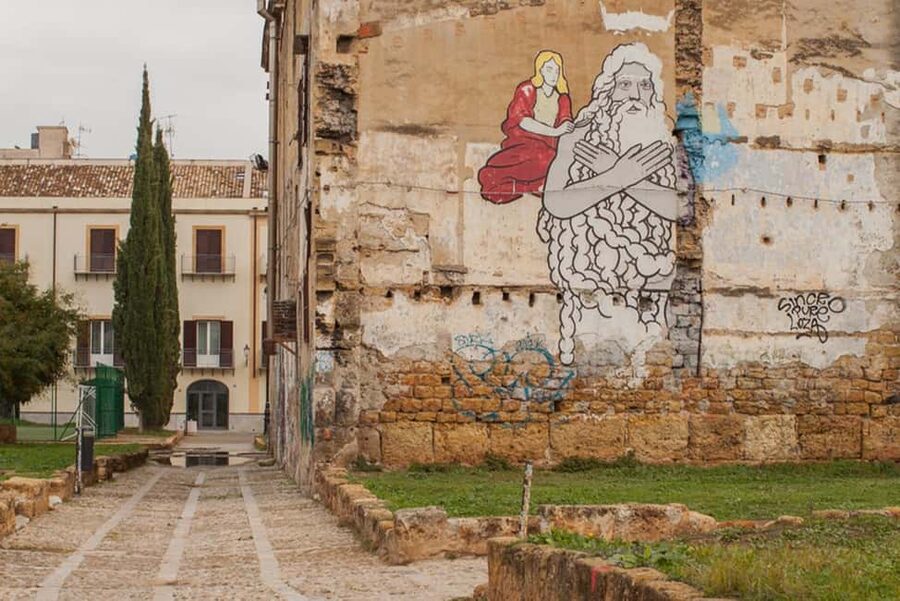
Palermo’s street art is not tucked away in a gallery. It appears on shutters, market walls, apartment blocks, and the ordinary corners of daily life. This walk takes you from Vucciria and Kalsa to Sperone, where large works by TVBoy, Millo, and Igor Scalisi Palminteri turn city walls into public conversation.
I like the mix of art and local context, especially the tram ride into a neighborhood most visitors miss. I also like the personal approach of Elena, whose explanations cover Palermo’s politics, mafia, struggles, and rebuilding without losing sight of humor or the city’s good side.
The main consideration is that this is not a landmark checklist. You will spend three hours walking, riding public transport, and looking at modern art in working neighborhoods. If you want Palermo’s cathedral and grand palaces, choose a traditional city tour instead.
Key points about Palermo’s street-art walk
- Vucciria and Kalsa begin the story: See murals, painted shutters, and everyday street scenes in two central districts.
- Sperone adds a different side of Palermo: A tram ride leads to large-scale works by Igor Scalisi Palminteri, Rosk and Loste, Medianeras, and Millo.
- Elena brings local insight: Her talks go beyond artists to cover Palermo’s social change, politics, mafia, and daily life.
- The group stays small: A maximum of 10 people makes it easier to ask questions and keep the walk conversational.
- Gelato is included: An artisanal gelato tasting gives the three-hour route a pleasant Sicilian finish.
- It is a city walk, not a museum visit: Art may change, events can alter the order of stops, and the experience depends on the living neighborhoods around it.
Why this tour shows a more useful Palermo
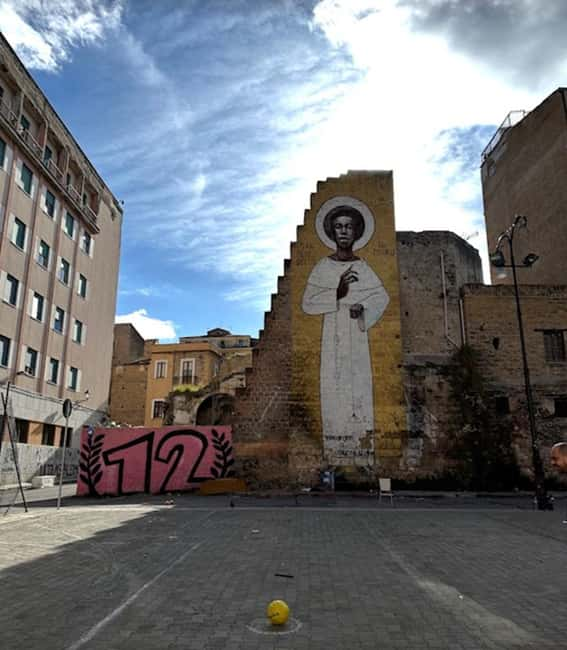
I like street art as a way to read a city. A painted wall can tell you about local pride, protest, hope, identity, or a neighborhood trying to change its public image. Palermo’s art makes the most sense when you see it beside market stalls, balconies, traffic, shutters, and people going about their day.
That is the point of this experience. You are not simply taken from one famous wall to another. You move through parts of Palermo where art is part of the street rather than a separate cultural product. The route begins in the center, then heads outward by tram, allowing you to compare the busy old districts with a quieter peripheral area.
I find that change of setting important. A central street-art walk can be enjoyable, but it may leave you with the impression that Palermo’s creative life exists only for visitors. The journey to Sperone gives you a better sense of how public art fits into a neighborhood with its own daily rhythm and social challenges.
The subject is also broader than painting. Elena’s talks include Palermo’s recent development, local politics, mafia history, and the city’s efforts to rebuild. That makes the art easier to understand. A mural is not just a large picture when you know something about the place where it appears.
More Street Art Tours around Italy:
- Naples Spanish Quarters Walking Tour Street Art, Folklore & Sweet
★ 5.0 · 797 reviews - Naples: Spanish Quarters Folk Street Art w/ Sweets Tasting
★ 4.9 · 788 reviews - Graffiti art tour in Rome
★ 5.0 · 714 reviews
Starting among shutters and markets in Vucciria
The meeting point is Epic Home on Via Argenteria, 20, in Vucciria. This is a handy central starting point for anyone already exploring Palermo’s old town. From there, you begin on foot, moving through Vucciria and toward the Kalsa.
Vucciria gives the tour an immediate sense of street life. Here, you look for murals, artistic shutters, and small details that are easy to miss when you are rushing toward a church or palace. The art sits among ordinary urban scenes, so you get a feel for how Palermo’s visual culture works outside formal exhibition spaces.
TVBoy is one of the artists connected with this part of the route. His work is often direct and easy to recognize, but the useful part of the tour is learning how a particular image connects with its setting. Elena can help you look beyond color and scale to the ideas behind a piece.
The first walking section lasts about 30 minutes. That is long enough to see several works without turning the opening into a hard march. You should still wear comfortable shoes. Palermo’s streets can be uneven, and the whole experience includes more walking later.
The quieter rhythm of Kalsa
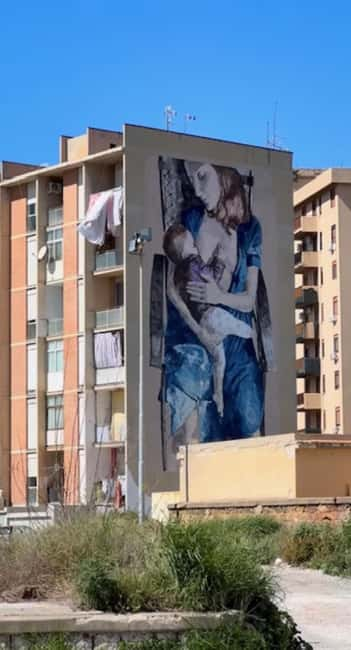
The route continues into Kalsa, a district with a different feel from Vucciria. You continue looking at street art and painted shutters, but the emphasis remains on the relationship between public art and everyday life.
I like this part because it slows the pace. In Vucciria, the street itself can demand your attention. Kalsa gives you more room to notice the smaller works and the way art appears on practical surfaces. SID is among the artists associated with the route, adding a local voice to the mix.
The guide’s role matters here. Without context, a shutter painting can be just a colorful door, and a mural can become a quick photograph. Elena’s strength is connecting those surfaces to the city around them. Her explanations have been described as broad, personal, and especially strong on the city’s difficult subjects, including crime, poverty, and rebuilding.
I would not expect a formal art-history lecture. This is a conversation while walking. That suits Palermo well, since the streets keep changing around you and the art is tied to place rather than displayed in a quiet room.
The tram ride to Sperone
After the central walking sections, you take a tram toward Sperone. The ride lasts about 15 minutes, and tram tickets are included in the $45 price.
This is more than a convenient transfer. The tram gives you a break from walking and lets you see Palermo from a different angle. It also makes the tour feel less like a fixed old-town circuit. You leave the most familiar visitor areas and head toward a neighborhood that many people would not reach during a short stay.
The order of stops can change because of weather, events, and local logistics. That is worth knowing before you book. Street art is exposed to the elements, and public neighborhoods cannot be managed like museum rooms. A flexible schedule is part of the experience.
You should also keep your expectations realistic. The tram is public transport, not a sightseeing vehicle with commentary at every turn. Its value is in taking you to a less familiar part of Palermo and showing how the city changes as you move away from the center.
Same walls, a different way in:
- Naples: Street Art, Wine and Food Tasting Walking Tour
★ 5.0 · 163 reviews - Naples Essentials: Monuments, Local Life & Street Art
★ 4.9 · 79 reviews - 4×4 tour of Orgosolo: Murals and typical lunch at the shepherd’s
★ 5.0 · 76 reviews - Rione Sanità tour among baroque, revival, street art & food
★ 4.8 · 59 reviews
Large walls and local projects in Sperone
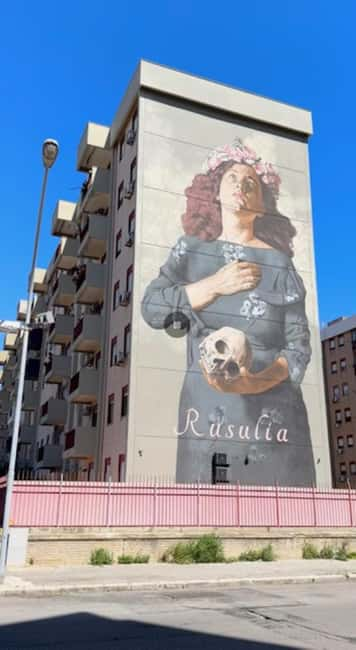
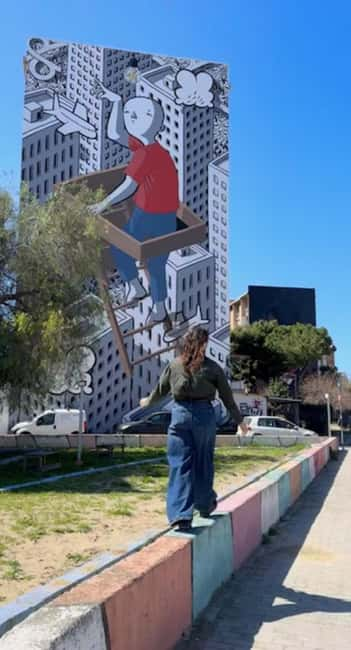
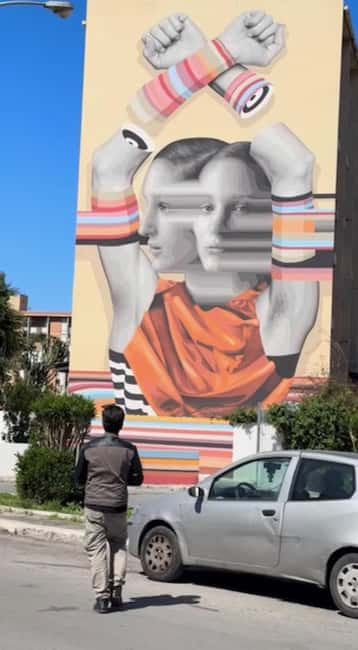
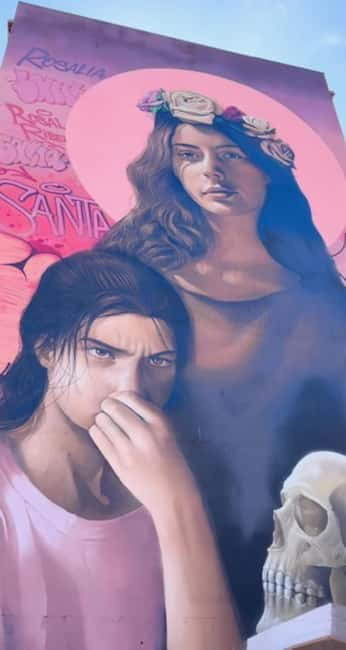
In Sperone, the art becomes larger in scale. Works by Igor Scalisi Palminteri, Rosk and Loste, Medianeras, and Millo form part of the neighborhood’s public visual life.
This is where the tour’s central idea becomes clearest. The walls are not simply decoration for an old street. They are tied to a neighborhood shaped by ordinary life, creative projects, and ongoing social change. A giant mural can give a building a new identity, draw attention to an area, or offer a message of hope without pretending that every problem has disappeared.
Igor Scalisi Palminteri is especially associated with public works that carry a strong social and human message. Millo’s large black-and-white compositions have a different visual character. Rosk and Loste and Medianeras add further variety, so the route does not feel like a single artist’s showcase.
I would give this section your full attention. Take time to look at how each piece uses the building, nearby streets, and surrounding homes. The best part is not only the artwork itself, but the contrast between carefully planned images and the untidy, lived-in city around them.
The walking section in this part of the route lasts about 30 minutes. Later, you take another tram for roughly 15 minutes, followed by a final walk of about 25 minutes before returning to Via Argenteria. In total, the schedule includes roughly 85 minutes of walking and 30 minutes on trams, with time for explanations and gelato.
What Elena adds to the experience
The guide can make or break a street-art tour. Here, Elena is the named guide, and her approach is clearly personal. She brings information about Palermo, but also an evident concern for the city and its people.
I would value her ability to move between subjects. You might begin with a mural, then learn about the artist, the building, a local issue, and the wider changes affecting Palermo. That range is one reason this walk appeals to people who have already seen the main sights and want more than another list of dates and architectural details.
Her style also seems suited to questions. The small group, limited to 10 people, gives you a reasonable chance to speak up. It is easier to ask why a work matters, how a neighborhood has changed, or what a symbol means when you are not standing among 30 or 40 people.
The conversations can also reach beyond the group. The experience is rooted in public streets, so you may encounter local residents or passersby. That does not turn the walk into a staged neighborhood show. It keeps the art connected to the people who live around it.
Gelato, timing, and the $45 price
At $45 per person, the tour is not the cheapest way to spend three hours in Palermo, but the value is fair if you want interpretation rather than a self-guided mural hunt. The price includes a specialized local guide, tram tickets, and an artisanal gelato tasting.
The tram tickets matter because the route covers more ground than a central walking tour. You are paying for access to a wider view of Palermo, not just for a guide to point out a few painted walls near the historic center.
The gelato is a small but welcome touch. It gives the route a distinctly Sicilian pause and breaks up the walking. Drinks are not included, so bring water, especially in warm weather. A hat, sunscreen, camera, and comfortable shoes are sensible choices.
Three hours is enough time to explore without making the day feel consumed by one activity. I would schedule it when you have energy for walking and curiosity for conversation. The route is not designed as a quick photo stop between major attractions.
Who will enjoy this walk most
I would recommend it to you if you have already seen Palermo’s principal landmarks or if you prefer daily life to a standard monument circuit. It suits people interested in public art, social issues, photography, urban change, and local voices.
It is also a good choice if you want a small group. A limit of 10 participants creates a more relaxed setting than a large coach-style outing. The guide can respond to questions, and the group can pause without creating a traffic jam.
Families with older children and teenagers may enjoy the visual subject and tram rides, though the experience still requires walking and listening. Art students, photographers, and anyone curious about how cities use public space should find plenty to consider.
I would hesitate if your main goal is historic architecture. You will see Palermo’s streets, but the walk is not built around the cathedral, Norman monuments, or palace interiors. It also may not suit you if you want a tightly fixed schedule. The order can change because of conditions on the ground.
The activity is wheelchair accessible, which is useful information when comparing options. Still, the route involves walking through city streets and using trams, so you should confirm any specific mobility needs before booking.
Practical details before you book
The tour is offered in English, Italian, and Spanish. Check the available starting time when you book, since the experience lasts three hours and the schedule can vary.
You can cancel up to 24 hours in advance for a full refund. The reserve-now, pay-later option is helpful if your Palermo plans are still shifting.
Meet at Epic Home, Via Argenteria, 20, in Vucciria. Arrive ready to walk, and carry water even though drinks are not included. Comfortable shoes matter more than fashionable ones here.
I would bring a camera, but try not to let photography take over. The point is to notice how the work sits in the city, not just to collect pictures of painted walls.
Should you book Palermo’s street-art walk?
Book this tour if you want Palermo explained through its people, public art, and changing neighborhoods. The strongest reasons are the small group, the tram ride to Sperone, and Elena’s ability to connect murals with politics, mafia history, hardship, and hope.
Skip it if you want a traditional introduction to Palermo’s major monuments or a short, easy stroll in the center. This experience asks for open eyes, comfortable shoes, and a willingness to see a part of the city that is less polished but more revealing.
For me, the $45 price makes sense because the route has a clear purpose. It does not treat street art as decoration. It shows how images on walls and shutters can become part of a neighborhood’s identity, and that is a useful way to understand Palermo beyond its postcard sights.
FAQ
Where does the Palermo street-art walk begin?
It begins at Epic Home, the tour operator’s base at Via Argenteria, 20, in Vucciria.
How long does the experience last?
The experience lasts three hours.
Which neighborhoods does the route visit?
The walk begins in Vucciria, continues through Kalsa, and then takes the tram to Sperone before returning to Via Argenteria.
Which artists might I see?
The route includes works associated with TVBoy, SID, Igor Scalisi Palminteri, Rosk and Loste, Medianeras, and Millo.
Is public transportation included?
Yes. Tram tickets are included in the price.
What languages are available?
The live tour guide is available in English, Italian, and Spanish.
Is the tour wheelchair accessible?
Yes, the experience is wheelchair accessible. The route still includes walking and tram travel, so you should consider your specific mobility needs before booking.
Freshly painted around Italy
- Art & Craft: Beer Tour with Street Art in Rome★ 4.5 · 6 reviews
- Torpignattara Photo Tour: melting pot, street art and politics★ 5.0 · 5 reviews
- Naples Murals Catacombs and Folklore Sanità District Tour★ 4.5 · 5 reviews
- Street Art of Spanish Quarters and Maradona Tour★ 3.5 · 3 reviews
- The Spanish Quarters, Street Art and Local Market Tour in Naples★ 5.0 · 23 reviews
- Private Street Art Tour: Exploring Milan’s Hype Neighborhoods★ 5.0 · 2 reviews
- Street Art&Urban Vibes in Milan’s Most Exciting Rising Areas★ 4.4 · 5 reviews
- Spanish Streets – Maradona Street Art & Murals★ 5.0 · 3 reviews
Italy Street Art Tours, compared.
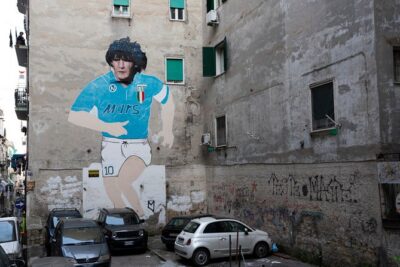
Naples Spanish Quarters Walking Tour Street Art, Folklore & Sweet
Read our review →
Naples: Spanish Quarters Folk Street Art w/ Sweets Tasting
Read our review →
Naples: Street Art, Wine and Food Tasting Walking Tour
Read our review →
Naples Essentials: Monuments, Local Life & Street Art
Read our review →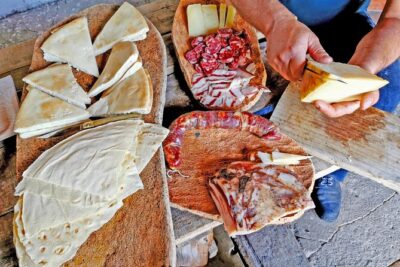
4×4 tour of Orgosolo: Murals and typical lunch at the shepherd’s
Read our review →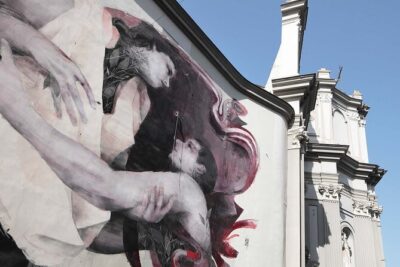
Rione Sanità tour among baroque, revival, street art & food
Read our review →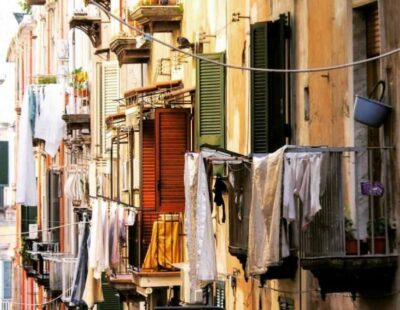
Naples: The Spanish Quarters, Street Art and Local Market
Read our review →Browse the lists this tour appears in