
Review · LONDON
East End London Instagrammable Street Art and Graffiti Tour
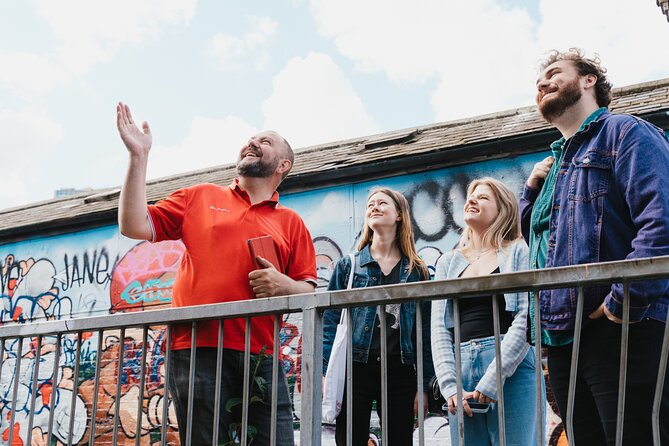
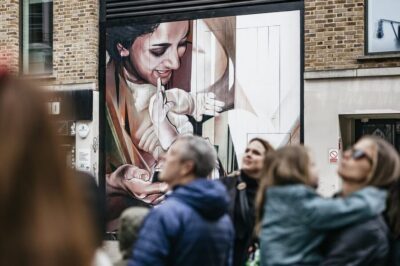
East London’s street art is not a museum collection. It changes, disappears, and sometimes gets painted over within days. This two-hour walk takes you from Whitechapel through Brick Lane and Shoreditch, pointing out giant murals, tiny stickers, old Banksy works, and pieces you could easily miss on your own.
I like the mix of famous names and local oddities. You’ll see Stik’s simple figures, ROA’s huge bird, Ben Eine’s bold lettering, and Thierry Noir’s cheerful heads, but you’ll also learn about broccoli stickers, graffiti writers, and the old graffiti wars. I also like that you get to make your own street art instead of only looking at other people’s work.
The main consideration is pace. There are many stops in a short time, and several are in narrow yards or along busy streets. At $49 per person, the value depends on how much context you want. If you only want quick photos, you can walk Brick Lane for free. If you want the stories, artists, and local background, the fee makes more sense.
Key things to know before you book
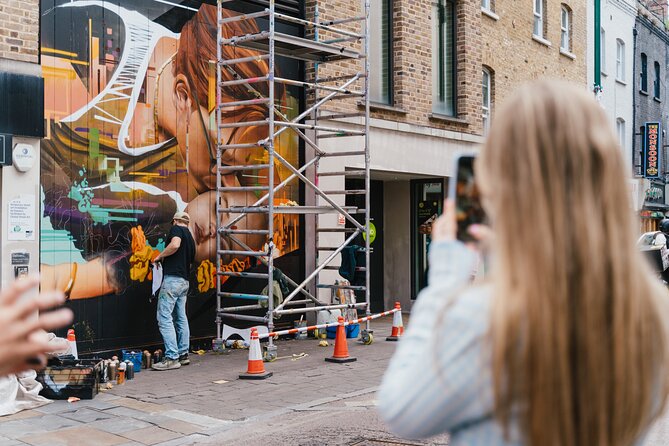
- Banksy appears in more than one form: You’ll see protected works on Rivington Street and a removed wall section displayed outside art’otel London Hoxton.
- The art keeps changing: Allen’s Gardens and several Brick Lane walls may look different from one day to the next.
- You make your own piece: The tour includes an opportunity to create street art, not just photograph it.
- The walk crosses several neighborhoods: It begins near Whitechapel High Street and ends within walking distance of Liverpool Street Station.
- The route mixes major artists with lesser-known work: Expect ROA, Stik, Ben Eine, Otto Schade, Martin Ron, Neon, and Thierry Noir.
- Small details matter: Stickers, stencils, painted slogans, and door-sized works receive as much attention as giant murals.
Why East London works so well for a street-art walk
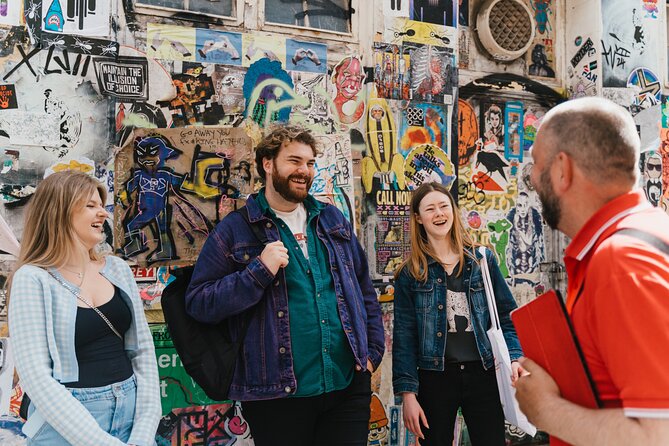
East London gives you a useful lesson in how public art lives. A mural may cover an entire building, while a sticker occupies only a few inches. One piece may stay for 20 years, and another may vanish after a few days. That uncertainty is part of the appeal.
The route also moves through places with different moods. Brick Lane has a rougher, older feel, with yards, pasted stickers, and layers of paint. Shoreditch brings larger walls, polished developments, and art connected to shops, hotels, and new buildings. By the end, the glass towers of the City begin to replace the old brick streets.
The guide’s job is not simply to point at a wall and name the artist. The best moments explain why the work is there, how the area changed, and why some paintings survive while others do not. You’ll hear about graffiti crews, community connections, disputed ownership, and the arguments that grew into the so-called graffiti wars.
The tour starts at 11 a.m. at 80 Whitechapel High Street. The finish is expected near Liverpool Street Station, though the exact end point can shift as the art changes. That is a sensible arrangement: you finish close to transport and can continue exploring East London on your own.
More Graffiti Tours in London:
- London: Street Art and Graffiti Guided Walking Tour
★ 4.9 · 1,354 reviews - Shoreditch Street Art and Graffiti Tour (Private Group Booking)
★ 5.0 · 108 reviews - ADVANCED GRAFFITI STREET ART TOUR / SHOREDITCH / EAST LONDON
★ 5.0 · 23 reviews
Heneage Street: giant walls in small spaces
The first stop brings you into the kind of tucked-away space that is easy to pass without noticing. At Heneage Street, two enormous pieces occupy building walls in small backyards.
Phlegm’s work features his familiar thin, elongated creatures, often perched high above layers of tags. The scale is impressive, but the details reward a closer look. Across the street, Fanakapan uses his signature silver helium balloons to reinterpret a familiar animated image. This is a good opening because you immediately see two different approaches: one surreal and finely drawn, the other bright, playful, and technically precise.
You get about 10 minutes here. Look up, not just straight ahead. The best view may be above eye level, and a wide-angle phone lens will help with the larger pieces.
Brick Lane doors and the art of stepping closer
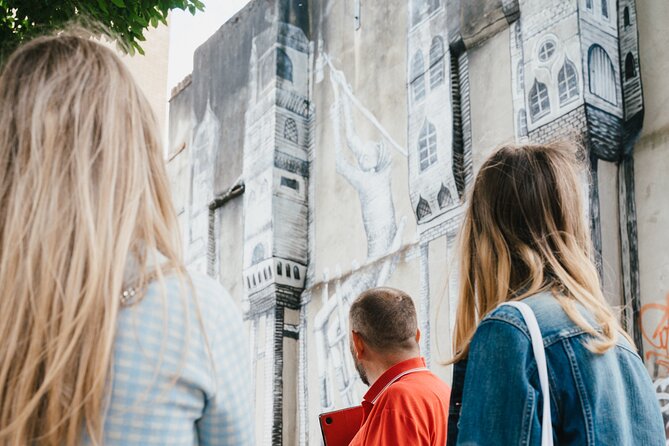
Brick Lane is often treated as one long outdoor gallery, but the smaller works deserve attention. The tour begins with Dan Kitchener and Perspicere, whose paintings appear on doors rather than huge walls.
The guide encourages you to view these pieces from different distances. From across the street, you see the overall shape. Step closer and you notice the unusual technical work and small details. That simple change in viewpoint is useful. Street art is often photographed too quickly, with the camera pressed against the wall.
This stop lasts only about five minutes, so the guide keeps the walk moving. Brick Lane itself can be crowded and active, so pay attention when stopping for photos.
Stickers, Princelet Street, and a local connection
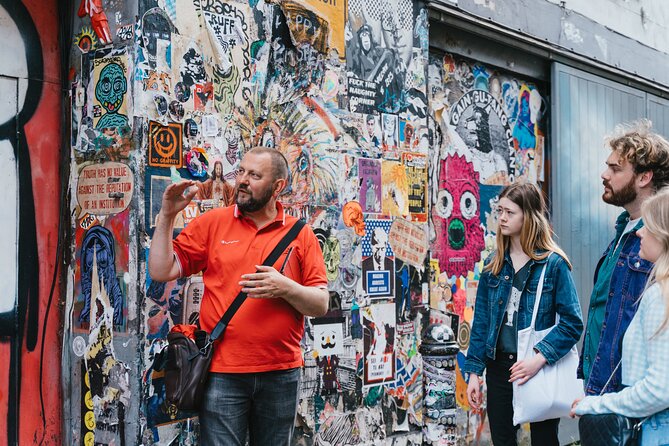
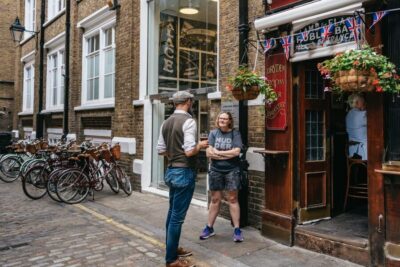
At The Seven Stars, the setting changes to a narrow, dirty yard covered with stickers. The guide treats stickers as their own art form rather than as decoration around the painted murals. You may even add a small piece of your own, making this the first clear hint that the walk is hands-on.
Princelet Street offers a more serious pause. A work by Stik is dedicated to the Muslim community and reflects Shoreditch’s long connection with refugees and immigrants. The design is simple, with strong color and clear figures. It has been defaced and repainted more than once, so its survival carries meaning beyond its appearance.
This is one of the better stops for understanding why location matters. The piece is not simply a colorful wall. It speaks to the people who live in the area and to the way public art can become part of a neighborhood’s identity.
More Street Art Tours around London:
- London Bike Tour: Landmarks, Secret Gems, Pub Stop & Street Art
★ 5.0 · 943 reviews - Shoreditch Street Art Tour London
★ 5.0 · 481 reviews - London: Landmarks & Secrets Bike Tour with Pub & Street Art
★ 4.9 · 314 reviews - The Original London Street Art Tour
★ 5.0 · 303 reviews
Hanbury Street: a giant bird and an upside-down man
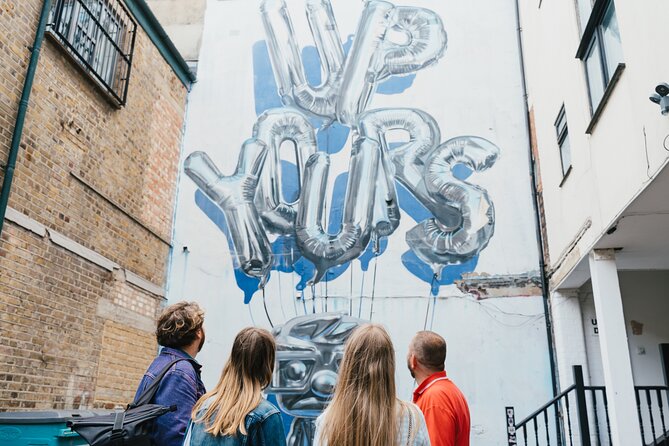
Hanbury Street gathers several styles into a small area. You’ll find stickers, black-and-white painted slogans by Wrdsmth, smaller colorful pieces, and two large works that have remained for roughly 20 years.
ROA’s bird is the first attention-grabber. Then look for Martin Ron’s upside-down man, whose body uses the existing features of the building. The scale is striking, but the clever use of doors, windows, and wall lines is even better.
In street-art terms, 20 years is a very long time. The guide uses these old pieces to explain how unusual it is for a work to survive in an area where walls change often. This is also a good place to take a portrait photo, since the art offers strong shapes and a clear background.
Dray Walk and the broccoli takeover
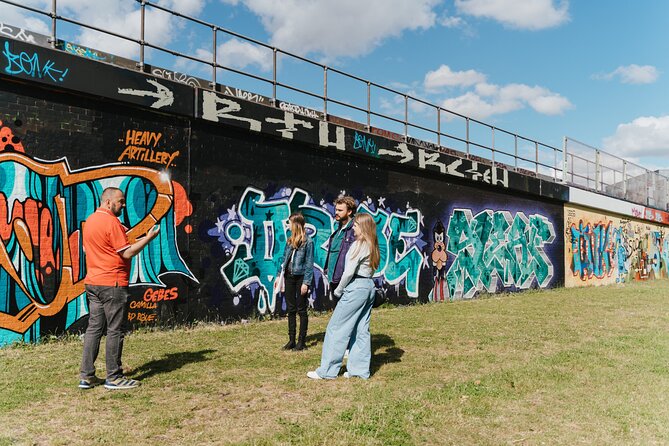
Dray Walk brings a lighter story. Look for broccoli images attached to walls and painted in colors far removed from the vegetable’s usual green. Artist Adrian Boswell started the trend, and the broccoli appeared so often that part of the street picked up the nickname Broccoli Lane.
The idea is amusing, but it also shows how a repeated image can become a local visual language. Boswell now has a gallery and sells broccoli pieces in frames, turning a street joke into a formal art practice.
This stop takes only five minutes. It is less about one grand mural and more about seeing how a simple symbol spreads through a neighborhood.
Allen’s Gardens: graffiti letters that are meant to be hard to read
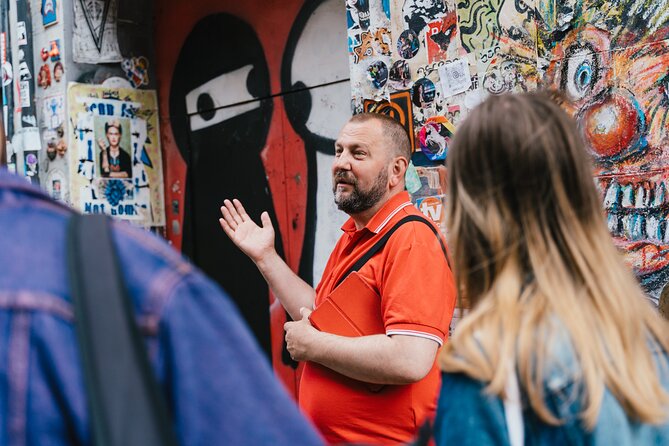
At Allen’s Gardens, the route moves away from the main street to a graffiti park surrounded by painted walls. Some works may change every few days, so photographs here record a moment rather than a permanent attraction.
Much of the work comes from graffiti writers, artists who focus on letters. The lettering can be so complex that you may not be able to read it at all. That is part of the challenge. The aim is often to create a personal style through shape, color, and movement, not to make a clear sign.
You’ll have about 10 minutes, which is enough to scan the walls and take photos. The drawback is that the work is temporary. You should not expect the images shown in advance to be there on the day of your walk.
Buxton Street and Ebor Street: from rough walls to polished Shoreditch
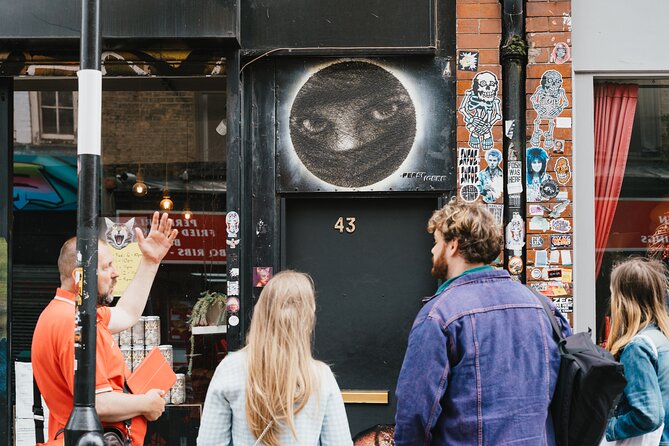
As you leave Allen’s Gardens, look up for the number 5 on Buxton Street. It introduces another artist and shows how a wall can combine work by several people. The guide explains how separate styles and colors can share one surface without becoming visual noise.
Ebor Street marks a change in mood. The route moves from the older, rougher feel around Brick Lane toward a more modern part of Shoreditch. You’ll see large painted advertisements and smaller works, including Neon’s pink portraits. The faces appear to have been made with a light mist of spray paint, yet the placement creates strong expressions.
On the same street, Ben Eine offers the opposite approach. His large letters are easy to read from a distance, but his fonts vary from ornate curves to sharp modern forms and simple blocks. This is a useful comparison between graffiti that asks you to decode it and lettering that wants to be seen immediately.
Together, the two Ebor Street stops show the range of the scene. You get atmospheric portraits, commercial-scale painting, and letters that function almost like architecture.
Rivington Street: Banksy, protected art, and room for debate
No East London street-art route would feel complete without Banksy, and Rivington Street provides a protected example. The works are covered with glass panels, which raises an obvious question: does preserving street art change what it is?
The guide leaves room for discussion about the art market, public ownership, trends, and personal taste. That is a useful approach. You do not have to admire every famous name, and the tour does not treat Banksy as the only artist worth seeing.
Nearby, Otto Schade’s work features ribbon-like forms. His stencils can appear light and open, yet they are full of energy. A half-seen soldier becomes complete when you move to the corner and view the wall from the right position. This is a small but satisfying example of how the route teaches you to look around the wall, not just at it.
Further along Rivington Street, Thierry Noir’s colorful heads bring a brighter note. Noir became known for painting the Berlin Wall in the 1980s, and his simple faces have continued to cheer up walls in other cities, including London.
A Banksy wall fragment outside an art hotel
At art’otel London Hoxton, you’ll see an unusual piece of street-art preservation: part of a wall painted by Banksy was removed from its original location and installed outside the hotel.
The setting is polished and modern, a sharp contrast with the rough yards and layered walls earlier in the walk. Yet the artwork has been returned to a public-facing position rather than hidden inside a private room. You can see it without booking a hotel stay.
This stop raises a bigger issue about what happens when street art is taken away from its original wall. The image may be protected, but the old surroundings and local context are gone. That tension gives the guide another chance to discuss who public art belongs to.
Shakespeare, Romeo and Juliet, and a changing neighborhood
Hewett Street adds a surprising historical note. Shakespeare sits on a bench marking the former site of the Curtain Theatre. You can sit beside him and look toward a striking Romeo and Juliet mural, a playful link between the site’s theatrical past and its current art.
The stop works because it is not only about graffiti. It shows how old stories and newer public art can share a small stretch of London. You may never again get such an easy photo beside Shakespeare, so allow a moment for it.
At New Inn Broadway, the route returns to modern painting. A single building is covered by the work of many artists, with different colors, techniques, and subjects fitted together like a large wall covering. Even a small policeman appears among the images.
The final walk toward Shoreditch High Street
The route finishes along Shoreditch High Street as the old brick streets give way to the glass and steel of the City. Before Liverpool Street, you’ll hear one more account of the graffiti wars, the conflict between artists, property owners, authorities, and different ideas about what belongs on a wall.
This ending gives the walk a clear shape. You begin with individual murals in small yards and finish thinking about public space, ownership, preservation, and redevelopment. It is more useful than ending with one final photo stop and no explanation.
What $49 gets you
The price is $49 per person, with free cancellation up to 24 hours before the start time. Since all the art itself is free, you are paying for the guide’s route, explanations, local context, and the chance to make your own street art.
For a person who already knows Brick Lane and only wants to photograph a few famous walls, the price may feel high. You can walk through much of the area without paying. But finding the less obvious yards, understanding the artists’ styles, and seeing works that are easy to miss gives the fee a practical purpose.
The small group limit of 20 also matters. This is not a private walk, but it is more manageable than a large coach-style outing. The tour is listed as roughly two hours, so the $49 cost is reasonable if you value concentrated guidance and want a clear introduction to East London’s art scene.
The tour is booked an average of 91 days ahead, so early planning is sensible, especially if you have only a few days in London. Your confirmation arrives at booking, and service animals are allowed. Most people can take part, though you should be ready for a steady urban walk, narrow yards, and frequent standing.
Who should book this walk?
I’d choose this tour if you like contemporary art, photography, local stories, or unusual parts of London that do not fit a standard sightseeing route. It suits first-time visitors who want an introduction to Brick Lane and Shoreditch, as well as repeat visitors who want help finding work beyond the main road.
Families with older children may enjoy the bold images and the chance to make art. It also works well for anyone who wants photo backdrops, though you should remember that walls change and some pieces may disappear.
I would skip it if you dislike walking, want a formal gallery experience, or expect every stop to feature a famous artist. The route is strongest when you enjoy contrast: grand murals beside stickers, serious community art beside broccoli, and preserved Banksy pieces beside work that may be gone next week.
Final verdict: a good choice for context, not just pictures
Book the East End London Instagrammable Street Art and Graffiti Tour if you want more than a checklist of famous walls. The most valuable parts are the explanations of style, survival, community, and conflict, plus the chance to make a small work of your own.
At $49, it is not the cheapest way to see Brick Lane. But the route covers a lot in two hours, includes major artists and temporary work, and finishes near Liverpool Street Station. Bring a charged phone, look above eye level, and be ready to change your expectations when a wall has changed since the route was planned.
FAQ
Where does the street-art tour start?
The tour starts at 80 Whitechapel High Street, London E1 7QX, at 11 a.m.
Where does the tour finish?
It finishes within walking distance of Liverpool Street Station. The exact end point may change depending on changing street art.
How long does the experience last?
The walking tour lasts approximately two hours.
Does the tour include Banksy artwork?
Yes. The route includes older Banksy works on Rivington Street and a section of a Banksy-painted wall displayed outside art’otel London Hoxton.
Can I make my own street art?
Yes. The experience includes an opportunity to create your own street art.
How many people can join the tour?
The maximum group size is 20 people.
Freshly painted around London
- London Street Art Tour of the East End Semi-Private 12ppl Max★ 5.0 · 23 reviews
- The Great Street Art Experience★ 5.0 · 2 reviews
- Private Royal London Bike Tour with pub & street art★ 5.0 · 2 reviews
- Shoreditch Street Art Private Photography Tour including Brick Lane★ 5.0 · 5 reviews
- London Street Art Tour of the East End Exclusive Walking Tour★ 5.0 · 12 reviews
- 3-Hour Private Tour of East London Graffiti & Street Art★ 4.5 · 5 reviews
- London Unexpected Private Tour – Markets, Street Art & Camden Town★ 5.0 · 2 reviews
- London East End – Guided Walking Tour 12 guests 2,5h★ 5.0 · 14 reviews
London Street Art Tours, compared.
London: Street Art and Graffiti Guided Walking Tour
Read our review →
London Bike Tour: Landmarks, Secret Gems, Pub Stop & Street Art
Read our review →
London: Landmarks & Secrets Bike Tour with Pub & Street Art
Read our review →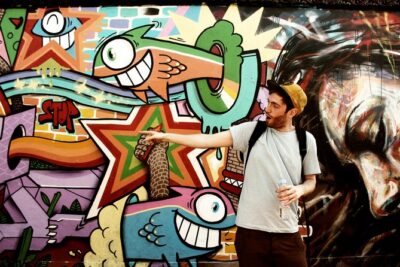
London: East End Street Art Tour and Spray Painting Workshop
Read our review →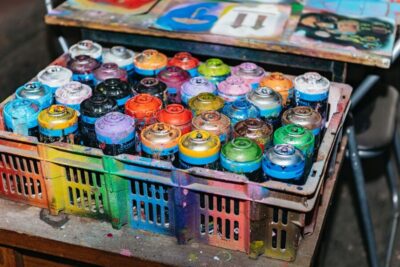
Shoreditch Street Art and Graffiti Tour (Private Group Booking)
Read our review →Browse the lists this tour appears in