Review · BELFAST
IRA Troubles Conflict Private Tour Museum Graves Murals and Political Analysis
Belfast’s Troubles story is written on its walls, graves, gates, and streets, and this private tour takes you straight into that difficult record. You move between the Falls and Shankill districts, see the peace walls up close, visit Milltown Cemetery, and enter a small Irish Republican museum not normally open to the public.
I like the private format for two reasons: you can ask direct questions, and the guide can adjust the route when a subject catches your interest. I also like the personal touch reported by several visitors, especially with guides such as Barry, Paula, and Joe, who connect the political story to their own lives in Belfast. The main drawback is clear: this is a Republican-focused tour, not a balanced account of both traditions, so you should choose another experience if you want equal weight given to Unionist and British viewpoints.
Key points to know before booking
- The tour follows an Irish Republican viewpoint, from earlier Irish history through the Troubles and the modern peace process.
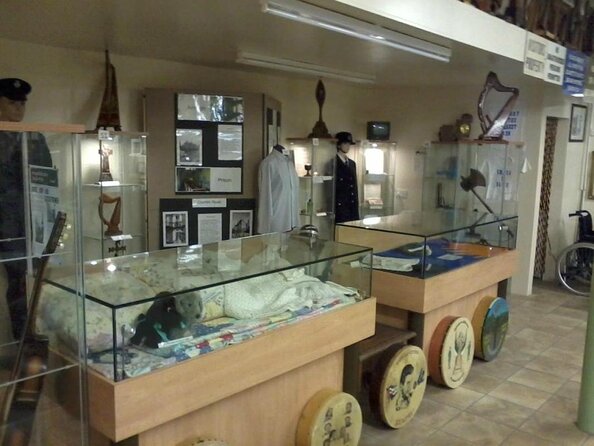
- The private museum is a rare feature, with photographs, objects, and contact with former Republican prisoners when open.
- Milltown Cemetery and the Clonard memorials are emotional stops, not quick photo opportunities.
- You see both sides of the divide, including Falls Road, Shankill Road, Republican murals, Loyalist murals, and the peace walls.
- The private vehicle saves time, allowing a large number of sites within roughly three hours.
- Museum timing matters: it opens from 10am to 2pm, Tuesday through Saturday, and the route changes to Ballymurphy if it is closed.
Why this Belfast tour feels different
Many Belfast excursions explain the Troubles from a broad civic or political angle. This one takes a declared Irish Republican position. That gives the tour a strong point of view, which can be exactly what you want if you are trying to understand how the conflict looked from Nationalist and Republican communities.
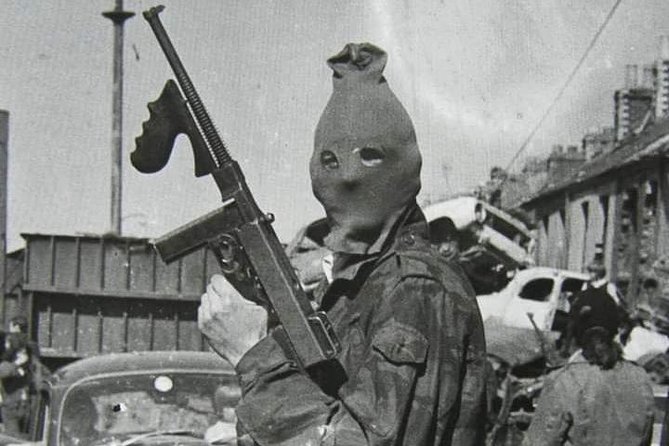
You will hear about the origins of the conflict, the formation and actions of the Provisional IRA, imprisonment, hunger strikes, British security policy, Loyalism, and the peace process. The guide also brings the story into the present, explaining that Belfast remains divided in practical ways, with barriers and gates still separating some districts.
The private setting matters. You are not tied to a large group moving from stop to stop. You can ask why a particular mural matters, how a memorial is used, or how people in the area remember a specific event. Several guides are named in the feedback, including Barry, Paula, Joe, Ciarán, Brendan, and Anton, so the person leading your tour may vary. Barry is repeatedly praised for tailoring the route and adding background from ancient Irish history through the modern period. Paula and Joe are also described as bringing personal experience to the subject.
The tone can be emotional and direct. That is part of the value, but it also means you should arrive ready to listen carefully. This is not a light city sightseeing trip with a few political murals added for color.
More Mural Tours in Belfast
- Belfast: Murals Taxi Tour
★ 4.9 · 2,047 reviews - Belfast’s Political Mural Taxi Tour
★ 5.0 · 1,180 reviews - Famous 1.5 hour Belfast Murals Tour
★ 5.0 · 477 reviews
Falls Road murals and the International Mural Wall
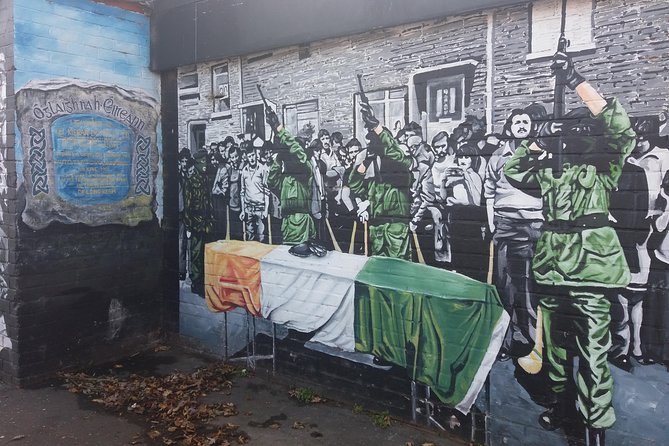
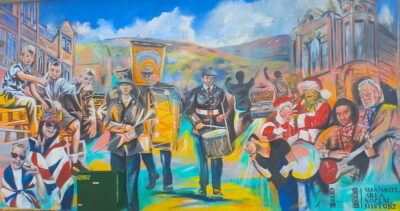
The tour begins around Divis Street and Falls Road, in the heart of Republican Belfast. The International Mural Wall presents political messages connected to Ireland, international struggles, peace, and community identity. It is a useful first stop because it shows how murals function here: not just as decoration, but as public statements.
Your guide sets out how the modern conflict developed from civil rights protests, sectarian violence, forced displacement, and competing claims over Northern Ireland’s future. You will hear the Republican explanation of how Nationalist neighborhoods experienced discrimination and violence, along with the later growth of armed groups and British military involvement.
The stop is short, listed at about ten minutes, so much of the detail comes while driving between locations. Take photographs, but do not treat the murals as isolated art pieces. Ask what each image means, who painted it, and how its message has changed over time.
This part of the route is particularly useful if you know the famous names but not the setting. The guide links the painted faces and slogans to streets, neighborhoods, prisons, memorials, and events nearby.
The peace walls between Falls and Shankill
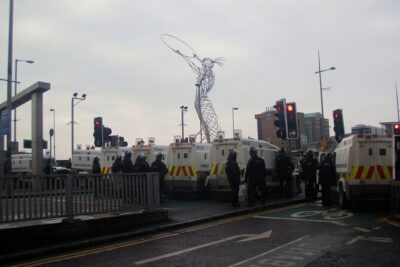
The peace walls are the most visible sign that Belfast’s divisions did not end with the 1998 peace agreement. These barriers separate predominantly Catholic Republican and Nationalist districts from predominantly Protestant Loyalist and Unionist districts.
You visit both sides of the wall and can sign it or leave a message of peace. That small act gives the stop a personal quality, but the wall itself remains a serious reminder that physical separation continues.
The first walls went up after sectarian riots in 1969, when homes in several areas were attacked and burned. They were meant to be temporary. Instead, they remained because they reduced immediate contact between rival communities. Some barriers were added after the IRA ceasefire in 1994, a reminder that peace did not instantly remove fear or mistrust.
One of the best-known barriers runs between the Falls and Shankill areas. It reaches about 800 metres and includes large concrete sections and gates. You may find the structure surprising because it looks less like a historic monument than a piece of active security infrastructure.
The practical lesson is simple: Belfast’s peace process brought a major reduction in violence, but reconciliation is not the same as removing every barrier. This is one of the strongest stops for understanding that difference.
Shankill Road and the Loyalist side
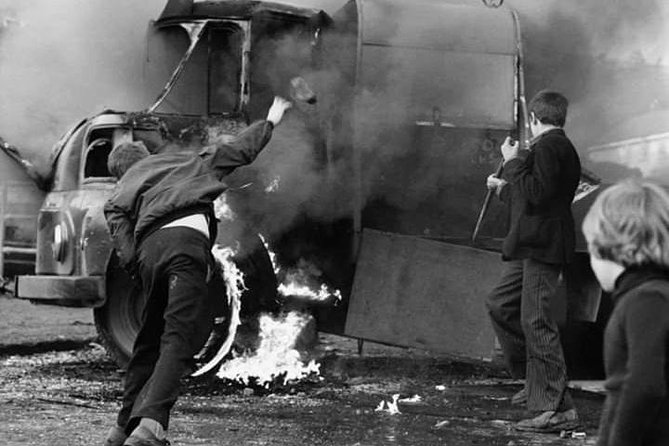
The route then crosses into Shankill Road, a center of Ulster Loyalism. Here you see murals connected with the UDA, UFF, and UVF, including imagery of masked men and weapons. The guide explains how Loyalism developed, why Unionists feared Irish unification, and how Loyalist paramilitary groups shaped the conflict.
Because the tour is Republican-focused, this section is presented as part of the Republican account of the conflict. You will learn about Loyalist activity, but you should not expect the same depth given to Republican aims, suffering, or internal debates.
That imbalance is not a surprise if you read the tour description carefully, but it matters when choosing. One visitor specifically felt that the Loyalist arguments received too little attention. If you want an even treatment of both communities, book a tour that promises a balanced Falls and Shankill presentation instead.
Still, visiting both sides is valuable. You can see how close the neighborhoods are, how quickly the political imagery changes, and how the physical boundary reflects a long-running argument over identity and sovereignty.
More Mural Tours in the UK
- Belfast: Private Black Taxi Cab Political Murals Tour
★ 4.9 · 425 reviews - Belfast Murals Taxi Tour
★ 5.0 · 341 reviews - Political Wall Murals and Peacewall
★ 4.9 · 247 reviews - Private Political History & Murals Tour Belfast
★ 5.0 · 182 reviews
Clonard Martyrs Memorial Garden
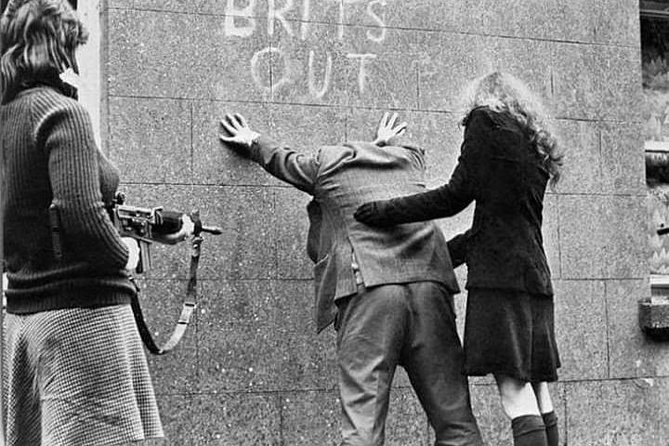
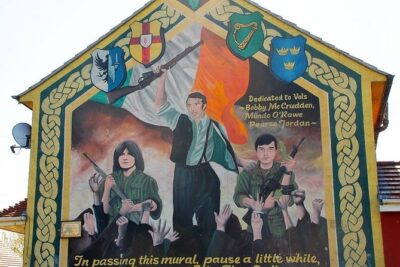
The Clonard Martyrs Memorial Garden is one of the more serious stops. It commemorates Republican volunteers, civilians, and Republican prisoners connected with the Greater Clonard area. The garden includes Celtic crosses, plaques, names, benches, and symbols linked to the Republican movement.
The first peace walls appeared after the violence of 1969, when Bombay Street was badly affected by attacks and fires. The memorial garden connects that local story to the wider conflict. The gate, the black and red phoenix, and the phrase about rising from the ashes all reflect how the Republican community remembers survival and sacrifice.
The memorial is divided into three yards. You will see a central Celtic cross, panels listing volunteers and civilians, plaques for prisoners from different periods, and memorial benches dedicated to local people. The names are not abstract. They represent families and neighborhoods that still use these places for remembrance.
Allow yourself time here. The stop is listed at about thirty minutes, longer than several mural visits, and that is appropriate. If you prefer a fast-moving sightseeing trip, this may feel slow. If you want to understand how memory works in Belfast, it is essential.
Milltown Cemetery and Bobby Sands
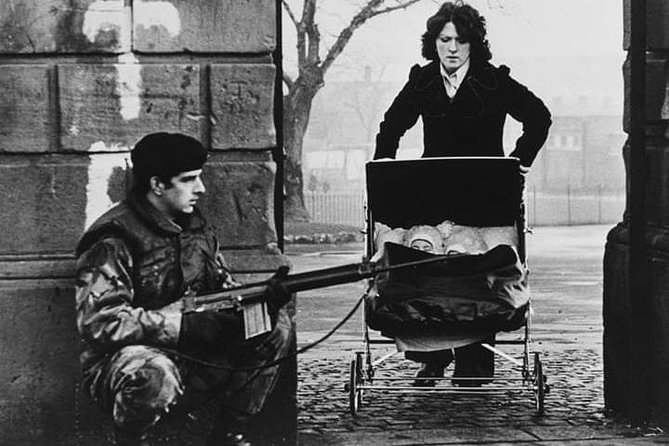
Milltown Cemetery contains several Republican plots and the graves of IRA volunteers from different periods. The tour focuses on the Republican plot and the resting place of Bobby Sands, who died after 66 days on hunger strike in 1981 while imprisoned at the Maze.
Sands had been elected as a Member of Parliament during the hunger strike, making his death an international political event as well as a central moment in Republican history. Your guide explains the blanket and dirty protests, the prisoners’ demand for special category status, and how the hunger strikes changed public opinion and political strategy.
The cemetery also contains graves cared for by the National Graves Association in Belfast. The New Republican Plot includes 77 IRA volunteers, including Óglach Mairéad Farrell. Red Hand markers identify many of the graves.
This is the stop that may affect you most. It is quiet, personal, and less theatrical than a mural. You see how the movement honors its dead and how the cemetery works as a place of political memory.
One caution comes from the timing. The cemetery receives about 25 minutes on the route, and one visitor felt that was too long. I can understand that if your main interest is murals or the museum. If you have family connections, research interests, or a serious interest in the hunger strikes, you may wish the cemetery had even more time.
Bobby Sands murals and Republican memorial gardens
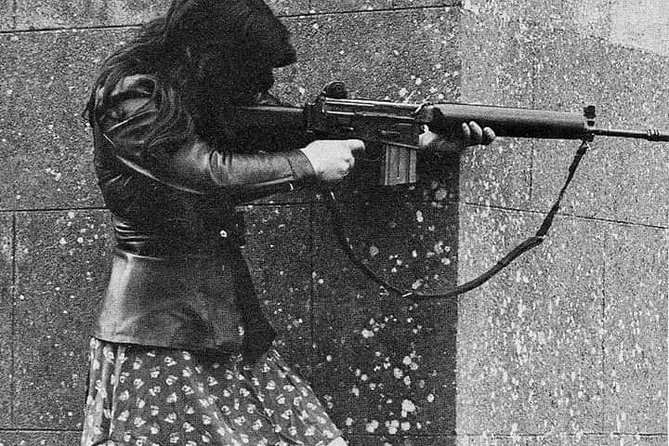
The tour visits more than one Bobby Sands mural, including the well-known image on the Falls Road. You will hear about Sands, the hunger strikes, and the way Republican communities use murals to preserve political memory.
You also visit the D Company, or 2nd Battalion, Belfast Brigade Garden of Remembrance. The Belfast Brigade was organized into battalions covering areas such as Andersonstown, Lenadoon, Twinbrook, Falls Road, Clonard, Ballymurphy, Ardoyne, the New Lodge, the Markets, Lower Ormeau, and Short Strand.
The guide discusses the Battle of the Falls in 1970, the Falls Road massacre of 1920, and local volunteers commemorated in the murals. At some stops, you may see photographs of 12 of the 22 hunger strikers.
The value here is local scale. National events can seem distant when you read about them in a book. These gardens and murals show how individual neighborhoods remember people by name.
You may also be shown plastic and rubber bullets used by British Crown forces. That tangible detail can make the security story easier to understand, though the tour’s handling of the subject remains firmly within a Republican narrative.
The private Irish Republican History Museum
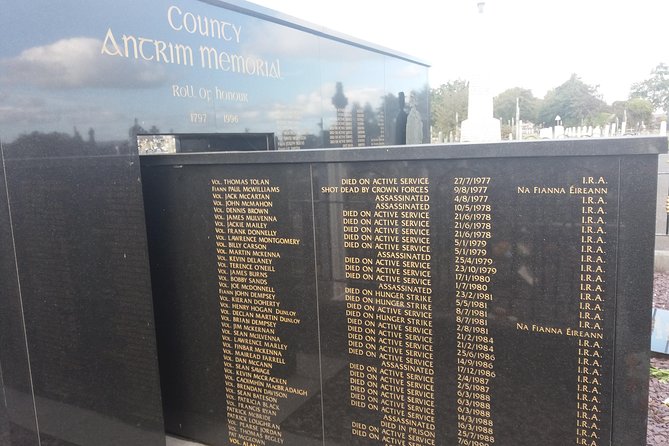
The private museum is the tour’s most unusual feature. It is the Eileen Hickey Irish Republican History Museum, which is not normally open to the public. The visit focuses on resistance to British rule, Republican history, and the conflict from an Irish Republican viewpoint.
You may meet former prisoners who share their experiences. That can bring a level of direct testimony that a standard museum display cannot provide. It also makes the visit more personal and potentially more intense.
The museum opens only from 10am to 2pm, Tuesday through Saturday. Check that your start time fits those hours. If it is closed, the tour substitutes a drive and walk around Ballymurphy, including local murals and memorials.
Ballymurphy is not a weak fallback. The area has murals connected with the Great Famine, local volunteers, Jim Bryson, and the weapon known as Big Louie. Still, the museum is a major reason to book this particular experience, so timing deserves attention before you pay.
Clonard Monastery and Divis Tower
Clonard Monastery sits near the interface between Falls Road and Shankill Road. During the violence of 1969, priests worked to help local residents after attacks and fires. The monastery was also home to Fathers Alec Reid and Gerry Reynolds, two Catholic priests associated with peace work.
This stop adds a religious and peace-building side to a tour otherwise centered on armed conflict and memorials. It shows that the area’s story includes mediation, humanitarian work, and attempts to build contact across the divide.
Divis Tower provides another striking viewpoint. The tower overlooked the Falls and once contained a British Army sniper position and observation post, which remained until 2005. You also see references to the first two victims of the Troubles.
The stop is short, about five minutes, but the tower helps explain how security operated in a dense urban neighborhood. You are not simply seeing where events happened. You are seeing how streets, rooftops, walls, and high-rise buildings shaped daily life.
Ballymurphy, Divis, and the final drive
The route through Ballymurphy and Divis brings together many themes from the tour: Republican identity, neighborhood memory, the famine, local volunteers, and the legacy of British military presence.
You will see a Welcome Wall and drive through an area regarded as a Republican stronghold. The route also includes a drive-by of Belfast’s largest peace wall. Since the tour covers a great deal in three hours, some of these stops are brief. You may take a quick photograph or listen while the guide explains what you are passing.
This is where the private vehicle earns its keep. You are not spending the whole morning walking between sites. The air-conditioned vehicle handles navigation and links districts that would be awkward to cover on foot in one short outing.
The tradeoff is pace. You cover murals, cemeteries, gardens, a museum, churches, tower blocks, and peace walls in roughly three hours. You get a strong overview, but you will not have long at every site.
Price, pickup, and who gets good value
At $255.50 per person, this is expensive for a three-hour city tour, especially for a couple or family paying separately. The price makes more sense if you value private transport, hotel pickup from the central meeting point, a tailored route, and access to the private museum.
Pickup is free from the Leonardo Hotel. Other central locations may involve a small extra fee, including Lanyon train station, St George’s Market, the Dublin train connection, Titanic Belfast, Crumlin Road Gaol, Queen’s University, the Botanical Gardens, and the Ulster Museum. Cruise port pickup and drop-off cost extra, and airport pickup is not offered.
You can also request a Mercedes-Benz V-Class upgrade for an additional £25 when available. Group discounts may improve the value for larger parties. The tour is offered in English, uses private transportation, and is suitable for most people who can participate in a vehicle-based sightseeing experience.
Free cancellation is available up to 24 hours before the start time. The tour is often booked well ahead, with an average booking point of about 81 days, so an early reservation may help if your Belfast dates are fixed.
Who should book this experience?
Book it if you want a close look at Republican Belfast, care about political history, and prefer asking questions rather than following a fixed script. It is especially suitable if you want Milltown Cemetery, Bobby Sands, the peace walls, and a museum visit in one compact outing.
It is also a good choice if you have only a short stay in Belfast. Several major sites are spread across West Belfast, and private transport lets you cover them without spending hours finding your way around.
Think twice if you want a neutral presentation. The tour openly favors the Republican account, and that is its purpose. You will see Loyalist areas and hear about British policy, but the interpretation gives greater attention to Republican history and memory.
Should you book this Belfast Troubles tour?
I would book this tour if the Republican perspective is what you are seeking. The combination of private transport, local guides, memorial gardens, Milltown Cemetery, peace walls, murals, and the small museum gives you access to parts of Belfast that a standard city tour may pass by.
Before booking, confirm the museum schedule and pickup fee. If you want both sides treated equally, choose a balanced political tour instead. If you want to understand how one community remembers the conflict, and you are ready for a serious, sometimes emotional three hours, this experience offers strong value despite its high price.
FAQ
How long does the tour last?
The tour lasts approximately three hours.
What perspective does the guide present?
The tour presents an Irish Republican perspective on Irish history, the Troubles, the IRA, Loyalism, British involvement, and the peace process.
Does the tour visit both Republican and Loyalist areas?
Yes. The route includes Republican areas such as Falls Road, Divis, Ballymurphy, and Clonard, as well as Loyalist Shankill Road and both sides of the peace wall.
Is the private museum always open?
No. The Irish Republican History Museum opens from 10am to 2pm, Tuesday through Saturday. If it is closed, the tour shows you around Ballymurphy instead.
Where is free pickup available?
Free pickup is available from the Leonardo Hotel in central Belfast. Other locations can involve extra charges, and airport pickup is not offered.
Can I cancel for a full refund?
Yes. You can cancel at least 24 hours before the local start time for a full refund. Cancellations or changes made less than 24 hours before departure are not refunded or accepted.
More Private Street Art Tours in the UK
- 2 Hour Terror and Mural History Belfast taxi Private Tour
★ 5.0 · 7 reviews - N0 1 Belfast black cab Irish and British mural 2hr private tour
★ 4.5 · 6 reviews - Belfast: Famous Murals Private Tour
★ 5.0 · 6 reviews - Private Belfast Mural & Giant’s Causeway Tour from Belfast (2 in 1)
★ 5.0 · 5 reviews
More Private Street Art Tours in Belfast
- 2 Hour Private Belfast Taxi Cab Tour of Troubles & Peace walls
★ 5.0 · 240 reviews - Award Winning Private 2 Hour Belfast Political Black Taxi Tour
★ 5.0 · 53 reviews - World Famous Private Belfast Troubles Taxi Cab Tour 2 Hour
★ 4.5 · 14 reviews - Belfast political history and mural unique private 90 min tour
★ 5.0 · 10 reviews
Freshly painted around Belfast
- Belfast history of terror & mural 1 hr express private taxi tour★ 5.0 · 3 reviews
- Falls road Murals Walking Tour with former prisoners★ 5.0 · 19 reviews
- 2 Hours Republican & Loyalist Mural Black Taxi Tour from Belfast★ 5.0 · 21 reviews
- 1 Hour Express Belfast Taxi/Cab Tour History, Murals, Troubles★ 5.0 · 17 reviews
- World Famous Private Belfast Troubles Taxi Cab Tour 2 Hour★ 4.5 · 14 reviews
- Belfast political history and mural unique private 90 min tour★ 5.0 · 10 reviews
- Private Belfast Mural & Giant’s Causeway Tour from Belfast (2 in 1)★ 5.0 · 5 reviews
- Belfast Cab Tour of Peacewalls, Murals and the Famous Titanic Slips★ 5.0 · 4 reviews
Belfast Street Art Tours, compared.
Belfast: Private Black Taxi Cab Political Murals Tour
Read our review →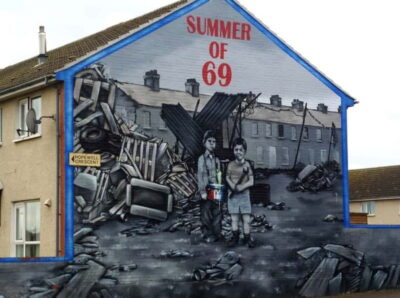
2 Hour Private Belfast Taxi Cab Tour of Troubles & Peace walls
Read our review →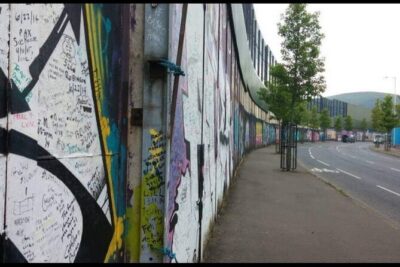
Private Political History & Murals Tour Belfast
Read our review →